

All About the Fighting and Killings in DR Congo

The Democratic Republic of Congo (DRC) has been plagued by conflict for decades, especially in its eastern region, which is rich in valuable minerals.
The root causes of this unrest are deep and complex, involving historical, political, and economic factors. Let’s take a closer look at what’s happening and why it matters.
Why is the East of DRC in Turmoil?
The eastern part of the DRC has been unstable for over 30 years. This started after the 1994 Rwandan genocide, when ethnic violence spilled over into the DRC.
Millions of people fled Rwanda into neighboring Congo, including Hutus responsible for the genocide. This influx of refugees caused tension in Congo, especially with the Tutsi communities already living there.
The region’s vast deposits of minerals, like gold, tin, and coltan (used in phones and electric vehicle batteries), have made it even more chaotic. Various armed groups have fought to control these resources, often using the profits to fund more violence.

What’s happening in Goma?
Goma, a city of over one million people in eastern DRC, has become a focal point in the conflict. Located near the Rwandan border and Lake Kivu, it is a major trade hub and close to rich mining areas. Recently, fighters from a group called M23 have advanced into the city, claiming control over parts of it.
The Congolese government denies that M23 fully controls Goma, saying its troops are still holding some key positions. This uncertainty has left residents in fear, with many fleeing for safety.
Who Are the M23 Rebels?
The M23 group takes its name from a peace deal signed on March 23, 2009. The group is led by ethnic Tutsis, who claim they are fighting to protect their rights as a minority. They believe previous peace agreements were not honored.
M23 first gained attention in 2012 when they captured Goma, but they were eventually defeated by the Congolese army and UN peacekeepers. Many of their fighters were integrated into the army with promises of safety for Tutsi communities. However, in 2021, the group resurfaced, saying those promises were broken.
What role does Rwanda play?
The fighting in eastern DRC is closely linked to Rwanda. While Rwanda denies supporting M23, UN reports and other sources accuse it of providing weapons and even commanding the group.
Rwanda’s involvement can be traced back to the 1994 genocide, when ethnic Hutus fled into Congo to escape the Tutsi-led Rwandan government. Rwanda has twice invaded Congo, claiming it needed to stop Hutu militias like the FDLR (Democratic Forces for the Liberation of Rwanda), which it views as a threat.
Critics, however, argue that Rwanda uses the conflict as an excuse to exploit Congo’s mineral wealth. Meanwhile, Congo accuses Rwanda of destabilizing the region for its own benefit.

What about the UN Peacekeepers?
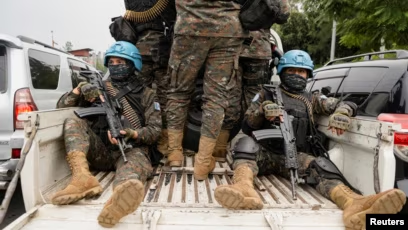
The UN has had peacekeepers in DRC since 1999. The current mission, Monusco, includes over 10,000 troops. However, their role is limited, and only certain units are allowed to carry out offensive operations.
While Monusco helped defeat M23 in 2013, many Congolese feel the mission has failed to protect them. This frustration has led to protests against the UN force. President Félix Tshisekedi has even called for Monusco to leave the country, though its mandate was extended for another year in December.
Other international forces, like those from the Southern African Development Community (SADC), have also joined the fight but have struggled to stop the rebels. In recent clashes, soldiers from South Africa, Malawi, and Uruguay lost their lives.
Why does this matter?
The conflict in the DRC is not just a local issue. The minerals mined in the region are essential for global industries, from electronics to green energy. Yet, the people living in these mineral-rich areas face unimaginable hardships.
At the same time, the violence has had devastating consequences, with millions of people killed or displaced over the years. Neighboring countries have also been drawn into the conflict, creating tensions across the region.
What’s happening in Goma?
Ending the fighting in the DRC requires a multifaceted approach. This includes addressing the root causes of the conflict, such as ethnic tensions and competition for resources. It also means holding accountable those who profit from the violence, whether they are armed groups, corrupt officials, or foreign actors.
While peace talks have been attempted, they often fall apart. A lasting solution will require genuine commitment from all sides, including neighboring countries like Rwanda, and support from the international community.


How the World Can Build 1.2 Billion New Jobs
The world is being shaped by two kinds of forces. Some hit fast and loud wars, market shoc…

Dangote Appoints Daughters to Top Executive Roles in Succession Plan
Africa’s richest businessman, Aliko Dangote, has moved three of his daughters into top executive …


