

Meet the People Running to Lead Africa’s Top Development Bank


This week, the African Development Bank (AfDB) is set to elect a new president, a decision that could significantly influence the continent’s financial future.
The vote, taking place during the bank’s annual meetings in Abidjan, Ivory Coast, comes at a time when Africa’s access to traditional development financing is tightening.
With concessional funds drying up, aid budgets shrinking in wealthier nations, and global interest rates rising, the AfDB’s $318 billion capital base has never been more critical.
These candidates from across the continent are in the race, each bringing a unique background and vision for the bank’s future. Here’s a look at who they are and what they’re promising to bring to the table.
Swazi Tshabalala Bajabulile – The Reformer

With over 30 years of experience in finance and banking, South Africa’s Swazi Tshabalala isn’t new to the AfDB. She recently served as the bank’s senior vice president and is the only woman in this year’s race.
Tshabalala is calling for a deep internal transformation of the institution, arguing that the current structure limits its ability to deliver effectively, particularly on infrastructure, one of Africa’s most urgent needs.
She envisions a more focused AfDB, capable of unlocking Africa’s potential in trade, mineral wealth, and investment through innovative financing tools, including hybrid capital instruments.
“If we get infrastructure right,” she says, “Africa can start turning its vast resources into real opportunities.”
Amadou Hott – The Self-Reliance Champion

Senegal’s former economy minister, Amadou Hott, has built his career across major financial hubs, from Lagos to London. His pitch? Make the AfDB a catalyst for Africa’s financial independence.
For Hott, the issue isn’t a lack of money, it’s a lack of strategy. He believes Africa must improve tax collection and create well-structured projects that attract private investment.
With African tax revenues averaging just 16% of GDP (compared to 34% in the OECD), Hott sees a chance to build stronger domestic funding systems that boost creditworthiness and reduce reliance on external debt.
“We need to bring private capital home,” he says. “The money exists. We just have to create the right vehicles for it.”
Samuel Munzele Maimbo – The Systems Fixer

On leave from the World Bank where he serves as a vice president, Zambia’s Samuel Maimbo is campaigning on the need to strengthen Africa’s internal systems. He’s not offering flashy promises, instead, he wants to tackle what he calls the “financial plumbing” of the continent.
Maimbo believes Africa must boost intra-continental trade and simplify the financial rules that govern movement of capital and goods. With just 15% of African trade happening within the continent, he says too much value is being lost or never realized at all.
“We’ve got to get trade working across borders,” Maimbo insists. “We need to align our financial systems, build shared data, and move from fragmented policies to regional solutions.”
Sidi Ould Tah – The Sovereignty Advocate
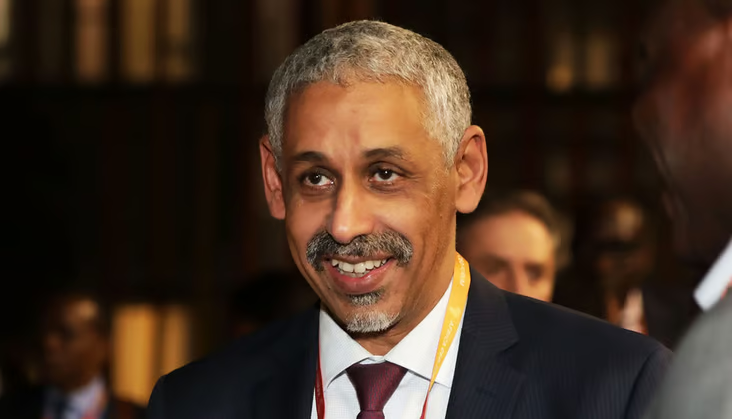
Representing Mauritania, Sidi Ould Tah brings ten years of experience running the Arab Bank for Economic Development in Africa. A former finance minister and presidential adviser, Tah is focused on giving African countries more control over their economic destinies.
His campaign centers on the idea of economic sovereignty, reducing dependency on legacy systems and external lenders. Tah wants the AfDB to be bold in how it deploys its resources, arguing that the institution must reposition itself as the driving force of Africa’s financial autonomy.
“It’s time for the bank to break free from old constraints,” he says, “and chart a new course for Africa’s future.”
What you should know
Whoever wins the presidency will take the reins of a bank with immense potential and growing responsibilities. With global development finance in flux, the AfDB will need strong leadership to stay relevant and effective.
Whether it’s through bold reforms, internal system overhauls, or stronger regional cooperation, all five candidates share one thing in common: a belief that Africa’s future lies in how well it manages its own financial tools.
The question now is, who will get the mandate to lead that charge?


Eid al-Fitr 2026: Saudi Arabia Says Weather Conditions Still Unclear
Saudi Arabian authorities have said weather conditions remain unclear as the country begin…

Eid al-Fitr 2026: Saudi Arabia Says Weather Conditions Still Unclear
Saudi Arabian authorities have said weather conditions remain unclear as the country begins efforts …


