

Africa’s richest man, Aliko Dangote, plans to dedicate about one-third of his fortune to philanthropy, a move that could amount to more than $12 billion based on his current estimated wealth.
His daughter, Halima Dangote, disclosed the plan in an interview with Bloomberg, saying the family supports his intention to direct a significant portion of his wealth towards charitable causes.
The disclosure goes beyond philanthropy. It also offers a clearer look at how the Dangote family is preparing for the future of Africa’s largest privately owned industrial empire as Dangote gradually gives his daughters greater responsibility across the group.
With Bloomberg’s Billionaires Index estimating his fortune at about $36.5 billion, one-third would be worth approximately $12.2 billion. If ultimately committed at that scale, it would stand among the largest philanthropic commitments associated with an African billionaire.

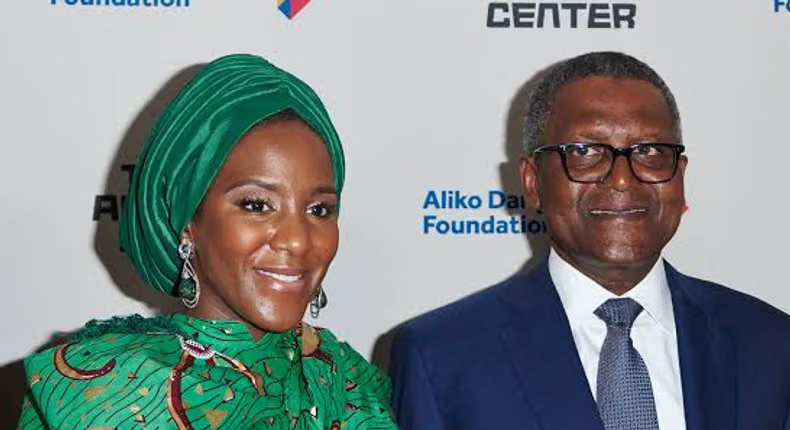
Halima Dangote, executive director of Aliko Dangote Foundation
Why the $12 Billion Figure Matters
Dangote’s plan would significantly expand the scale of private philanthropy associated with African wealth.
At an estimated $36.5 billion fortune, giving away one-third would mean directing roughly $12.2 billion to charitable purposes.
That amount alone would be larger than the annual budgets of some African governments and could fund major long-term programmes across healthcare, education, nutrition and poverty reduction if deployed over time.
But there is an important distinction.
Halima’s comments indicate Dangote’s intention to dedicate one-third of his wealth to philanthropy. That does not mean $12 billion has already been transferred into a foundation or distributed to charitable organisations.
The final amount would also depend on the value of Dangote’s fortune when the commitment is implemented.
Most of his wealth is tied to businesses rather than sitting as cash, meaning any large-scale philanthropic transfer would require decisions about assets, ownership structures and how the money would be deployed.
Philanthropy Is Already Part of the Dangote Empire
Dangote’s charitable activities are not new.
The Aliko Dangote Foundation was established in 1994 and has grown into one of Africa’s largest privately funded philanthropic organisations.
The foundation has an endowment of about $1.25 billion and has supported programmes covering healthcare, nutrition, education, disaster relief and poverty reduction.
Its work has included vaccination programmes, maternal and child health initiatives, school feeding projects and humanitarian interventions.
The foundation has also worked with governments and major international organisations, including the Bill & Melinda Gates Foundation, on public health initiatives across Africa.
Dangote has previously said he spends significantly more on philanthropy than on himself and wants his wealth to have a lasting impact.
The proposed one-third commitment would take that philosophy much further.
The Bigger Story Is Succession
The public support from Dangote’s children may be just as important as the size of the proposed donation.
For some billionaire families, plans for transferring wealth and corporate control remain largely private until the founder dies or formally retires.
The Dangote family appears to be taking a different approach.
Its next generation is already being incorporated into important parts of the business while Dangote remains actively involved.
That creates a succession model built around two parallel objectives: preserving and expanding the industrial empire while deciding how much of the family’s wealth should ultimately serve a broader social purpose.
For investors and business partners, this matters because succession risk can become a major issue in founder-led businesses.
A company heavily dependent on one individual can face uncertainty when that founder leaves. Introducing the next generation early gives them time to build experience, relationships and operational authority.
Dangote, who is expected to turn 70 in 2027, appears to be addressing that challenge before it becomes urgent.
What This Means for the Dangote Group
Committing one-third of Dangote’s personal fortune to philanthropy does not necessarily mean giving away one-third of the operating businesses.
The structure of any future donation will matter.
Dangote’s wealth is largely derived from stakes in major companies and industrial assets. How those holdings are eventually divided between heirs, foundations and other structures could influence ownership of the group over the long term.
But the family’s public backing reduces one potential source of tension.
Halima’s comments suggest the next generation accepts that a substantial portion of the wealth created by their father may ultimately be directed towards philanthropy rather than inherited privately.
That could make it easier to separate the succession of management from the succession of wealth.
The daughters could assume larger leadership responsibilities across the group even as part of the founder’s personal fortune is transferred to philanthropic causes.
What This Means for Africa
Africa has produced a growing number of billionaires, but philanthropy on the scale associated with some of the world’s wealthiest families remains less common.
A commitment exceeding $12 billion could change that conversation.
The impact, however, will depend on how the money is deployed.
Large philanthropic commitments can generate the greatest long-term value when they target structural problems rather than one-off interventions. Across Africa, those opportunities include education, public health, nutrition, entrepreneurship, infrastructure and poverty reduction.
Dangote’s existing foundation provides a platform through which some of that work could be expanded.
The bigger question is whether his plan could also influence other wealthy African families to think differently about legacy.
Dangote has spent decades building one of Africa’s largest industrial fortunes.
The next phase of that story may be defined not only by how much bigger the business becomes, but by how much of the wealth it created is eventually returned to society.
What You Should Know
Dangote has spent decades building an industrial group with interests spanning cement, fertiliser, sugar, salt, food processing and energy.
The centrepiece of his recent expansion is the 650,000-barrel-per-day Dangote Petroleum Refinery, Why is Dangote Refinery Selling Petrol in Dollars? one of the biggest industrial investments ever undertaken by a private African company.
At the same time, the family has been preparing for what happens beyond the founder.
Dangote’s three daughters, Halima, Fatima and Mariya, have taken on increasingly important roles as the group pursues an ambitious plan to grow into a $100 billion business by the end of the decade.
Halima oversees the family’s offices in Dubai and London and serves as an executive director of the Aliko Dangote Foundation.
Fatima has taken a leading commercial role in the group’s energy operations, while Mariya is involved in commercial strategy across its food and cement businesses.
Their growing responsibilities suggest that succession at Dangote Group is already being built into the company’s operating structure rather than left until the founder eventually steps away.


