
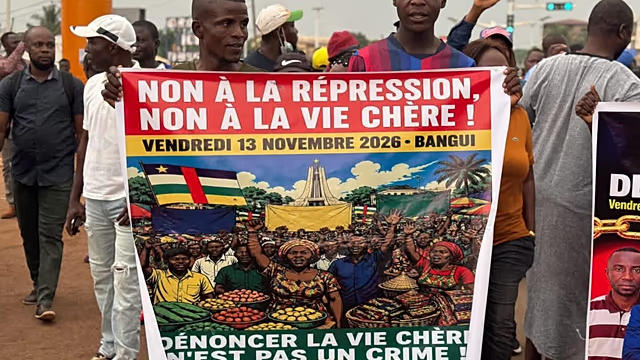
Hundreds of protesters marched through the streets of Bangui on Friday, demanding urgent government intervention to curb the surging cost of living in the Central African Republic (CAR).
The demonstrations, led by opposition figures and civil society groups, focused on the rapid inflation of essential commodities and the perceived failure of the state to protect consumers from price volatility.
The protests also coincided with demands for the release of five civil society leaders who were recently arrested, further intensifying the tension between the administration of President Faustin-Archange Touadéra and grassroots economic advocacy groups.
According to reporting from Africanews, the marchers highlighted the struggle of ordinary citizens to afford basic food items and fuel, which have seen significant price hikes in recent months.
The unrest reflects a deeper economic crisis in one of the world’s poorest nations, where food insecurity is systemic and the urban population is particularly vulnerable to global price shocks.
Import Dependencies and Inflationary Pressures
The Central African Republic is a landlocked nation, making its domestic markets heavily dependent on imports from neighbouring countries, primarily Cameroon and Chad. This reliance leaves the CAR economy exposed to transport costs and supply chain disruptions at the port of Douala.
Data from the World Bank indicates that the CAR’s economy remains fragile, with growth often offset by high inflation and a lack of diversified production. When global commodity prices rise, the impact is felt immediately in Bangui’s markets due to the lack of domestic substitutes for staples.
The country operates within the Central African Economic and Monetary Community (CEMAC) and uses the CFA franc, which is pegged to the euro. While this peg provides some monetary stability, it limits the government’s ability to use independent monetary policy to combat domestic inflation.
Local traders in Bangui have noted that the cost of transporting goods across the border has increased, a cost that is invariably passed on to the end consumer. This has created a cycle of price increases that outpaces the stagnant wages of the public and private sector workforce.
The arrest of civil society leaders, who have been vocal about these economic grievances, has shifted the narrative from a purely financial struggle to one of political repression. Opposition leaders argue that the government is silencing those who highlight the failure of its economic policies.
The International Monetary Fund has previously emphasised the need for the CAR to strengthen its public financial management and improve the business climate to attract the investment needed to reduce import dependency.
Despite various infrastructure projects aimed at improving connectivity, the high cost of doing business in the CAR continues to deter large-scale agricultural investment that could lower food prices.
The current volatility in Bangui suggests that economic hardship is now reaching a tipping point where it is triggering widespread social instability. For the business community, such unrest increases the risk profile for foreign direct investment and disrupts the operation of SMEs in the capital.
The CAR government has not yet announced a specific package of subsidies or price controls to address the protesters’ demands. The next critical step will be whether the administration chooses to engage in dialogue with civil society or continues its security-led approach to managing the dissent.
Explore more Money stories and analysis from Business Elites Africa.


