
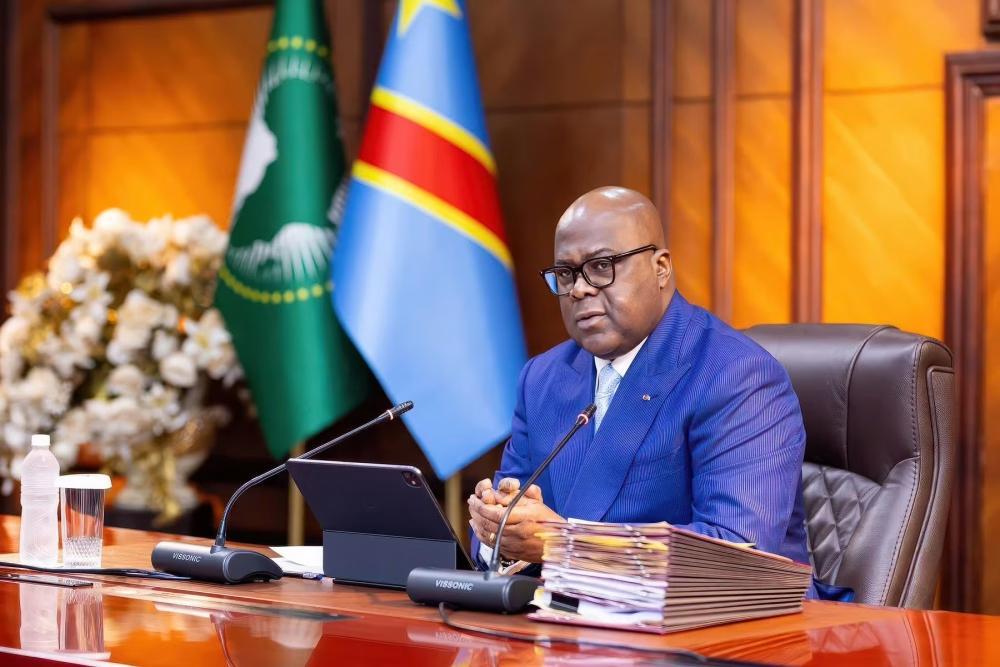
President Félix Tshisekedi has announced a comprehensive national dialogue aimed at establishing peace, cohesion, and the renewal of the state in the Democratic Republic of Congo (DRC).
The move follows months of political hesitation and comes as the administration seeks to resolve deep-seated instability that has hindered the country’s governance and economic potential.
The initiative is a blend of political pragmatism and calculation, appearing just over two years before the end of the current mandate.
The dialogue is intended to address the fragmented state of the nation, particularly the security crisis in the eastern provinces where armed groups continue to disrupt local administration and commercial activity.
For the Tshisekedi administration, the dialogue represents an attempt to broaden its political base and create a sustainable framework for state authority across the DRC’s vast and often ungoverned territories.
This shift toward a consultative process suggests a recognition that military solutions alone have failed to secure the east or provide the institutional stability required to attract long-term foreign direct investment.
Mining Sector Stability and Investment Risks
The drive for “state renewal” carries significant weight for the DRC’s economy, which is heavily dependent on the extraction of critical minerals. The country is the world’s largest producer of cobalt and a leading producer of copper, both essential for the global transition to green energy.
Persistent conflict in the east and political volatility in Kinshasa have historically created a high-risk environment for international mining firms. Stability in state institutions is a primary requirement for companies operating under the World Bank’s identified economic frameworks for the region.
Investors typically seek predictable regulatory environments and the rule of law, both of which are targeted by the proposed “renewal of the state.” Any successful dialogue that leads to a more cohesive government could reduce the risk premiums associated with DRC projects.
The DRC’s mining sector has faced scrutiny over labour practices and transparency. A renewed state apparatus could potentially implement more robust oversight and a more transparent IMF-supported economic management strategy.
However, the success of this dialogue depends on the inclusion of genuine opposition figures and the willingness of armed factions to transition from conflict to political participation.
If the dialogue is perceived as a mere tool for political survival rather than a sincere effort at reform, it may fail to provide the institutional guarantees that global markets require for expanded investment.
The timing of the announcement is critical, as the DRC continues to navigate complex relations with regional neighbours and global powers, including China and the United States, both of which are competing for influence over the country’s mineral wealth.
The administration now faces the challenge of defining the parameters of the dialogue and ensuring that the resulting agreements are binding and implementable.
The next phase of the process will involve the selection of participants and the establishment of a formal agenda to address the specific legal and administrative hurdles facing the state.
Explore more Politics stories and analysis from Business Elites Africa.


