
What began as a localized border anomaly at the tip of North Africa has erupted into a geopolitical firestorm. The crisis in Ceuta—Spain’s tiny 18-square-kilometer autonomous enclave bordering Morocco—has quickly transcended a regional migration dispute. Instead, it has become a masterclass in how localized events are weaponized online to shift political narratives across Europe and the United States.
1. The Spark: Anatomy of a “Teacup Storm”
The crisis was ignited not by a sudden geopolitical conflict or catastrophe, but by a viral wave of digital misinformation.
- The Rumor Mill: Following a misconstrued ruling by the Spanish Supreme Court regarding sea returns, localized Arabic-language networks (such as the Hrig Sebta groups) falsely claimed that Spain’s borders were effectively open to anyone who swam around the breakwaters.
- The Influx: Driven by economic desperation and these misleading online posts, over 70,000 migrants—predominantly young Moroccan men—attempted to enter the enclave by swimming or scaling perimeter fences.
- The Human Reality: Behind the sensational headlines lies a devastating human cost, with over 80 documented deaths at sea and local reception facilities overwhelmed at over 2,000% capacity.
2. The Weaponization: How the Far-Right Seized the Narrative
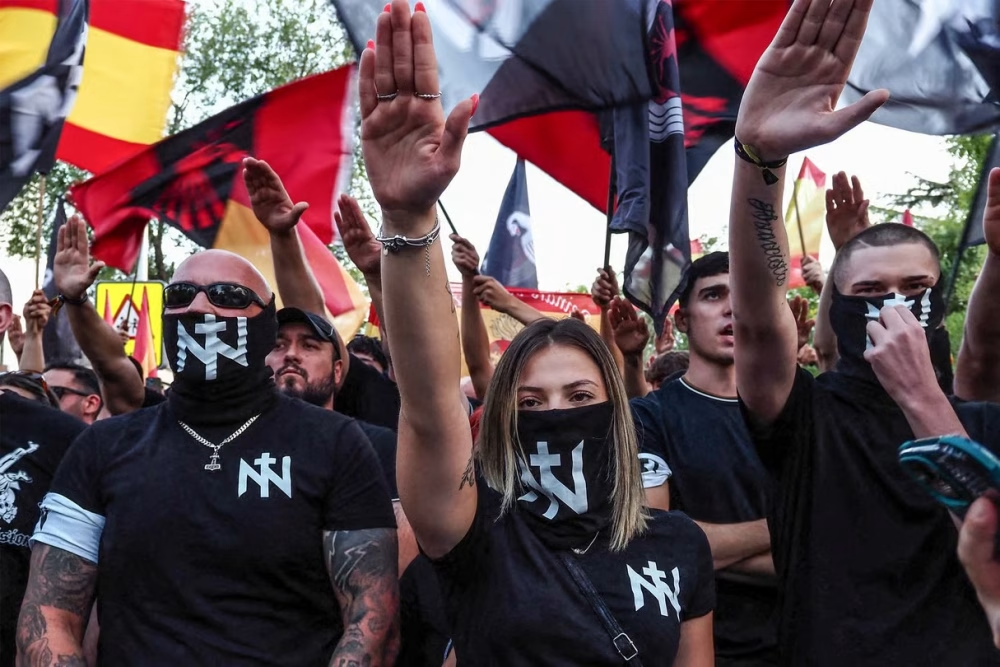
While Spanish authorities scrambled to handle the immediate pressure on the ground, nationalist political figures and online networks acted swiftly. The visual imagery of thousands swimming toward European soil was immediately converted into high-octane political currency:
- Spreading the “Second Wave” Myth: Far-right influencers and politicians across Europe—including figures in Germany’s AfD, Britain, and Portugal’s Chega—began circulating recycled footage and false claims of an ongoing “African invasion” and imminent disease outbreaks to stoke public fear.
- Breaking the Schengen Union: Italy’s Prime Minister Giorgia Meloni unilaterally reinstated border checks on travel from Spain, prompting Madrid to retaliate with matching controls. The move severely rattled the EU’s passport-free Schengen zone.
- Electoral Fuel Across Europe: With major elections on the horizon in France, Germany, Spain, and Poland, right-wing leaders have used the optics of Ceuta to argue that liberal migration policies are a direct threat to national sovereignty.
- Transatlantic Echoes: US conservative commentators and Trump-aligned figures quickly latched onto the footage, framing Ceuta as a cautionary tale of “open borders” to bolster hardline domestic immigration platforms.
3. Hybrid Warfare and Information Chaos
Spanish Prime Minister Pedro Sánchez directly addressed the fallout, pointing to foreign state actors and coordinated online campaigns for amplifying the crisis. While human traffickers initiated the initial rumor cycle, foreign networks leveraged the event to exploit existing political fault lines within the European Union.
┌────────────────────────┐ ┌─────────────────────────┐ ┌────────────────────────┐│ Misinformation Spark │ ───► │ Physical Border Surge │ ───► │ Political Leverage ││ False online rumors │ │ Mass entry into Ceuta │ │ Weaponized optics for ││ & court misreadings │ │ strains local infra │ │ electoral gain │└────────────────────────┘ └─────────────────────────┘ └────────────────────────┘
- Digital Borderlands: Modern borders are no longer enforced solely with steel and concrete—they are deeply vulnerable to information networks and social media algorithms.
- Erosion of EU Solidarity: The crisis revealed how quickly internal European unity can fracture under border strain, with member states turning to retaliatory border checks.
- The Playbook: Ceuta serves as a case study for how localized migration events can be rapidly globalized to fuel nationalist campaigns across the Western world.
Explore more Business stories and analysis from Business Elites Africa.


