
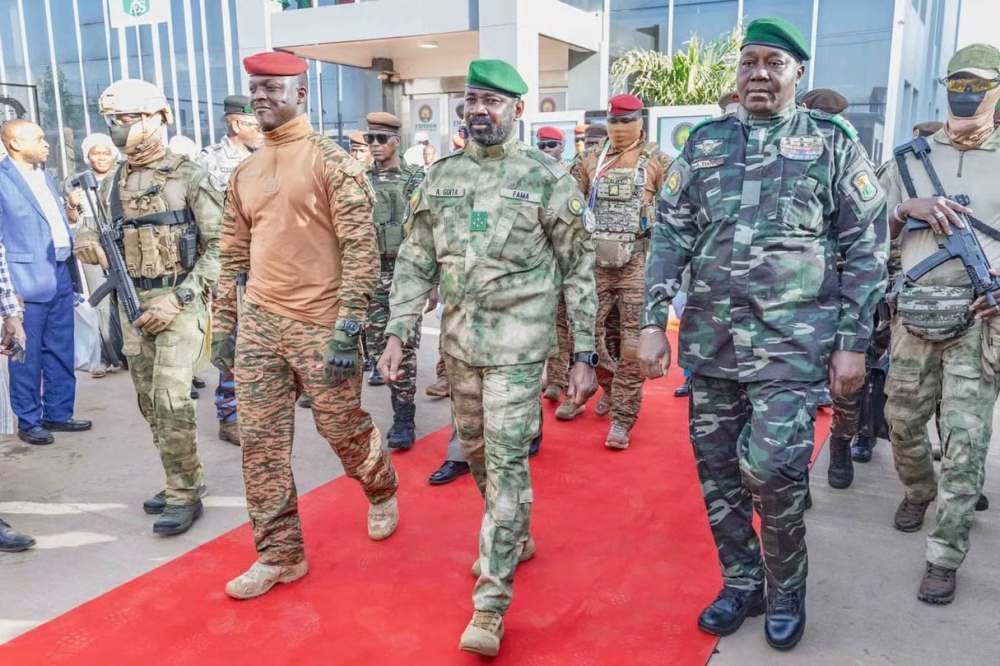
The failure of the Alliance of Sahel States (AES) to mobilise during the mutiny of 28–29 August against General Abdourahamane Tiani has raised urgent questions regarding the operational viability of the regional bloc’s mutual defence pact. Despite the signing of the Liptako-Gourma Charter nearly three years ago, the absence of a coordinated response from Mali and Burkina Faso suggests that the alliance remains more of a political statement than a functional military reality.
During the two-day period of unrest in Niamey, which saw elements of the Nigerien military challenge Tiani’s leadership, the expected intervention from neighbouring Bamako and Ouagadougou did not materialise. This lack of action occurred despite Article 6 of the charter, which mandates that any attack on the sovereignty or territorial integrity of one member state shall be considered an aggression against the others, requiring assistance including the use of armed force.
The incident has rattled investors and diplomatic observers who had been monitoring the AES as a potential alternative to the Economic Community of West African States (ECOWAS). For Niger, a nation increasingly reliant on its burgeoning oil sector and historical uranium exports, the internal instability threatens to undermine the fragile economic recovery that followed the lifting of post-coup sanctions earlier this year. The Africa Report noted that the failure to act highlights the difficulty the three countries face in turning shared defence ambitions into a tangible security apparatus.
Internal reports suggest that while General Tiani remained in control of the presidential palace, the communication breakdown between the AES capitals was significant. Sources within the regional security framework indicate that while Mali and Burkina Faso expressed verbal support, neither country possessed the logistical capacity to deploy rapid intervention forces to Niamey on such short notice without compromising their own internal security against jihadist insurgencies.
Regional Economic Stability and Investor Confidence
The inability of the AES to secure its own members has direct consequences for the commercial landscape of the Sahel. Since exiting ECOWAS, the three nations have sought to create a unified economic zone, including plans for a common currency and a regional investment bank. However, these ambitious projects rely heavily on the perception of a stable and unified security front. The recent mutiny in Niamey suggests that the transition from military juntas to a cohesive sovereign bloc is fraught with domestic challenges that transcend regional treaties.
For the business community, Niger’s stability is critical due to its role in regional energy infrastructure. The Niger-Benin oil pipeline, a vital artery for the country’s revenue, remains sensitive to shifts in the military hierarchy. Any prolonged internal friction within the Nigerien armed forces could lead to disruptions in production or delayed maintenance, impacting the government’s ability to service its growing debt obligations and fund its portion of the AES joint initiatives.
Furthermore, the mining sector, dominated by uranium interests involving international firms, requires a predictable security environment. The mutiny highlighted that while the Tiani administration has consolidated power at the executive level, the underlying grievances within the middle and lower ranks of the military—often related to pay, equipment, and the grueling nature of counter-insurgency operations—remain unresolved. These factors create a high-risk environment for long-term capital expenditure in the extractive industries.
The geopolitical implications are equally significant. The AES was formed partly as a rejection of Western and ECOWAS influence, yet the recent crisis demonstrates that the bloc remains geographically and logistically isolated. Without the logistical support structures previously provided by international partners, the member states are finding that their “sovereign” security model is difficult to sustain during moments of acute domestic crisis.
In the aftermath of the mutiny, General Tiani has reportedly begun a fresh purge of the military ranks, aimed at removing dissenting voices. While this may secure his position in the short term, it risks further alienating the professional soldier class. The AES leadership is expected to hold an emergency meeting in Ouagadougou next month to discuss the formal activation of a joint permanent strike force, though funding and command structure remain major points of contention.
The coming months will be a test of whether the AES can evolve beyond its current status. For businesses operating in the region, the focus remains on whether these military administrations can provide the stability necessary for trade and investment, or if the Sahel will remain a theatre of perpetual internal power struggles. The next stage of the Nigerien transition, including the management of oil revenues and the potential for inclusive military reform, will be the primary indicator of the country’s economic trajectory heading into 2027.
Explore more News stories and analysis from Business Elites Africa.


