

Nigeria’s FX Reforms and Rising Oil Prices: What It Means for the Economy


Nigeria’s economy is once again facing two powerful forces: foreign exchange (FX) reforms and rising global oil prices. While these changes usually signal relief for Africa’s largest oil producer, the situation in 2026 is more complex.
This explainer looks at what these shifts mean for growth, inflation, businesses, and everyday Nigerians.
What Are Nigeria’s FX Reforms and Why Do They Matter?
Nigeria’s FX reforms, started under President Bola Tinubu, aim to unify exchange rates, increase dollar liquidity, and restore investor confidence. So far, these policies have begun to stabilize the naira and strengthen external reserves.
Recent data shows Nigeria’s reserves rose above $46 billion, reflecting improved inflows and market confidence linked to FX reforms.
The reforms also include changes in how oil revenues are managed. A new rule requires that all oil and gas revenues go directly into the federation account, improving transparency and fiscal discipline.
Together, these policies aim to correct long-term issues in Nigeria’s currency market and lessen reliance on parallel exchange rates.
How Are Rising Oil Prices Changing the Equation?
Global oil prices have surged in recent weeks, nearing $100 per barrel, which is much higher than Nigeria’s 2026 budget benchmark of about $64.
Under normal conditions, this would significantly boost:
- Government revenue
- Foreign exchange inflows
- External reserves
Analysts point out that higher crude prices often strengthen dollar inflows and ease pressure on external buffers. However, Nigeria’s situation is more complicated.
Why Nigeria May Not Fully Benefit from High Oil Prices
Despite the price surge, experts warn that Nigeria’s benefits are limited by structural issues.
Moses Umoru, Director-General of the Franco-Nigeria Chamber of Commerce and Industry, explains, “The apparent windfall comes with significant constraints.”
A key limitation is Nigeria’s reliance on crude-backed loans and forward sales agreements, which lock in oil deliveries at previously agreed, often lower prices.
This means:
- A portion of Nigeria’s oil is already committed
- Current high prices do not fully translate into new revenue
- Fiscal flexibility remains limited
Moreover, oil production is still below targets. While the government projected about 1.84 million barrels per day, actual output has been closer to 1.48 million barrels per day in early 2026.
The Inflation Problem: A Double-Edged Sword
Rising oil prices are not only a revenue issue; they also lead to inflation.
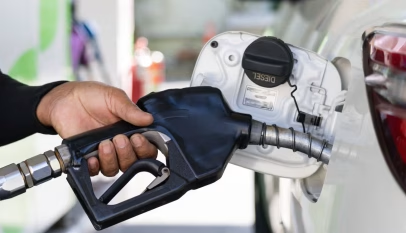
As global crude prices rise, domestic fuel costs sharply increase. In Nigeria, petrol prices have reportedly jumped from around ₦750 to as high as ₦1,400 per litre in some areas.
This creates a dual effect:
- Positive: Higher export earnings and FX inflows
- Negative: Increased cost of living and business expenses
For households facing high food prices, the pressure is significant. Even the World Bank has warned that inflation remains a heavy burden despite economic growth.
What This Means for the Naira and FX Stability
The mix of FX reforms and rising oil prices is starting to stabilize Nigeria’s currency outlook.
Key improvements include:
- Stronger foreign reserves
- Increased investor confidence
- Better FX market transparency
Additionally, policies like the crude-for-naira initiative aim to reduce dollar demand within the domestic economy.
As Dangote Refinery CEO David Bird clarified, according to reports, “The crude for naira program is to provide resilience to foreign exchange.”
If sustained, these measures could reduce exchange rate volatility and improve long-term economic stability.
Impact on Businesses and Investors
For businesses, the current environment offers both opportunities and risks.
Opportunities:
- Improved FX access and predictability
- Stronger economic signals
- Possible increase in government spending from oil revenues
Risks:
- Rising operating costs due to inflation
- Weak consumer spending
- Continued exposure to oil price fluctuations
PwC notes that businesses should focus less on guessing oil prices and more on building resilience: “Resilience will depend less on predicting oil prices and more on building operating models that can withstand volatility.”
Broader Economic Outlook
Nigeria’s medium-term outlook remains cautiously optimistic.
The Central Bank projects:
- GDP growth: ~4.49% in 2026
- Inflation: easing but still high
- Stronger external buffers from reforms
However, the country’s heavy dependence on oil, about 80% of government revenue, continues to expose it to global shocks.
The Bottom Line
What do Nigeria’s FX reforms and rising oil prices mean for the economy?
- They are improving FX stability and boosting reserves.
- But benefits from high oil prices are limited by debt obligations and low production.
- Inflation remains a major downside, affecting households and businesses.
- Long-term gains depend on sustained reforms, higher oil output, and diversification.
Final Analysis
Nigeria is at a crucial economic turning point. FX reforms are establishing a more transparent and stable financial system, while rising oil prices present a potential, though limited, revenue boost.
Yet the country’s economic future will depend less on oil price cycles and more on its ability to turn reforms into real improvements in productivity, investment, and living standards.
Until then, the promise of an oil windfall remains, at best, partial.




10 Proven Strategies to Attract and Retain Loyal Customers
In a time of fierce competition and changing customer expectations, businesses that excel …

How African Billionaires Prepare Heirs for Leadership
Wealth in Africa is growing, and with it, a new generation of potential leaders …


