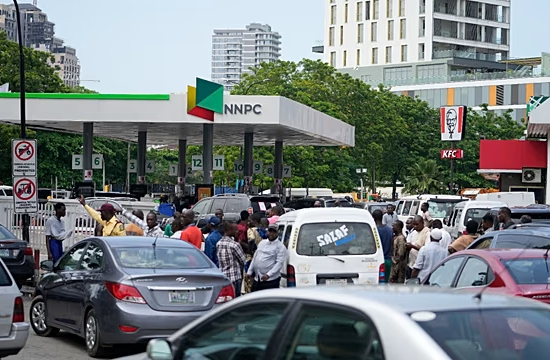
The Organisation of the Petroleum Exporting Countries (OPEC) has reduced its global oil demand growth forecast for 2026 by over 70 per cent, signaling a significant cooling in expected consumption.
The intergovernmental organisation revised its projection for 2026 growth down to 400,000 barrels per day (bpd), a massive drop from the previous estimate of 1.4 million bpd. This downward revision suggests that the global energy market is facing much weaker demand dynamics than previously anticipated by the group’s analysts.
The change in outlook, detailed in the latest OPEC market reports, reflects a combination of shifting macroeconomic indicators and the increasing pace of the global energy transition. Analysts suggest that slower industrial activity in major consuming economies and the rapid expansion of renewable energy infrastructure are contributing to the revised figures.
The substantial reduction in growth expectations comes at a time when oil-producing nations are already navigating a complex landscape of price volatility and production management. By lowering the growth ceiling, OPEC is acknowledging that the era of rapid, high-volume demand expansion for crude oil may be facing structural headwinds.
Fiscal Risks for Oil-Exporting Nations
For oil-exporting economies, particularly in Africa, the reduced demand growth forecast presents a significant fiscal challenge. Nations such as Nigeria, which rely heavily on petroleum revenues to fund national budgets and service external debt, face heightened uncertainty regarding future oil income.
A slowdown in demand growth typically exerts downward pressure on crude oil prices. If the market anticipates a surplus or a lack of growth in consumption, the price per barrel may stagnate or decline, directly impacting the foreign exchange reserves and the budgetary stability of net exporters.
The International Energy Agency (IEA) has also noted similar trends, highlighting how the deployment of electric vehicles and improvements in energy efficiency are beginning to decouple economic growth from oil consumption. This structural shift means that even during periods of economic recovery, demand for traditional fossil fuels may not rebound as robustly as in previous decades.
The revision also impacts the strategy of the OPEC+ alliance, which includes non-OPEC members like Russia. The group has frequently used production cuts to support prices and manage global supply. However, if the fundamental driver of price strength—demand growth—is significantly lower, the effectiveness of supply-side management may be tested.
Market participants are now closely monitoring whether OPEC members will adjust their individual production targets to compensate for the lower growth outlook. Any significant shift in production quotas could lead to immediate volatility in the Brent and West African crude benchmarks.
In Nigeria, the implications extend to the broader energy sector and infrastructure investments. With the government’s recent focus on diversifying the economy and increasing domestic refining capacity, a period of lower-than-expected oil demand could influence the pace of capital expenditure in the upstream sector.
Industry experts suggest that the revised 2026 forecast may force a reassessment of long-term investment projects. As the margin for error in demand forecasting narrows, oil companies may become more cautious with large-scale, high-cost exploration and development projects in deepwater assets.
The next major indicator for the market will be the upcoming OPEC+ ministerial meeting, where members are expected to discuss production levels in light of these revised demand projections. Investors will also be looking for updates from major consuming economies regarding their industrial output and energy policies, which remain the primary drivers of global oil demand.
Explore more Oil & Gas stories and analysis from Business Elites Africa.