
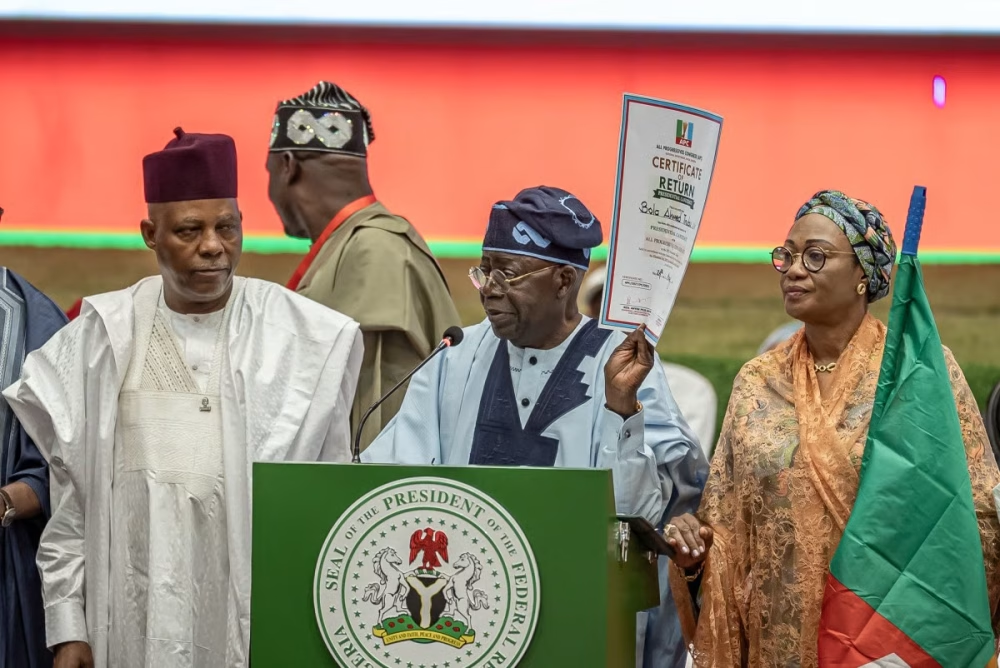
President Bola Tinubu is restructuring his political alliances in the North West, utilising the influence of Abdulaziz Yari to weaken opposition fragments ahead of the 2027 presidential election.
The integration of Yari into the president’s campaign council signals a strategic shift to consolidate power in one of Nigeria’s most critical voting blocs.
According to reporting by The Africa Report, this move is designed to hollow out the remaining influence of the People’s Democratic Party (PDP) and the New Nigeria People’s Party (NNPP) in the region.
Abdulaziz Yari, the former governor of Zamfara State, is regarded as a regional strongman with deep grassroots networks. His alignment with the administration provides the All Progressives Congress (APC) with a potent mechanism to co-opt local leaders who previously supported the opposition.
The strategy comes as the opposition struggles to find a unified front. The PDP continues to face internal frictions, while the NNPP’s influence has become increasingly concentrated rather than broad-based.
By securing high-profile loyalists like Yari, the president is attempting to create a dominant political coalition that reduces the risk of a contested or volatile transition in 2027.
North West Political Alignment and Market Stability
The North West geopolitical zone is essential for any candidate seeking the presidency due to its massive population and voting capacity. Beyond the ballot box, the stability of this region is tied to national economic security.
The region is a primary hub for Nigerian agriculture and mining. Political volatility or fractured leadership in the North West often correlates with security instabilities that disrupt food supply chains and investment in extractive industries.
Investors and international financial institutions typically view political consolidation as a sign of predictability. A fragmented opposition often leads to protracted legal battles and social unrest, which can deter foreign direct investment.
The administration’s focus on the North West also aligns with broader efforts to stabilise the agrarian economy, which is central to the government’s inflation-fighting measures and food security goals.
However, some analysts suggest that relying on regional power brokers can create internal tensions within the APC. The balance between central authority and the demands of regional “strongmen” has historically been a point of friction within the party.
The current approach suggests the president is prioritising a “big tent” strategy, bringing in diverse and powerful figures to ensure a smoother path to reelection regardless of internal ideological differences.
The success of this bet depends on Yari’s ability to deliver the promised grassroots support and the APC’s capacity to manage the expectations of these new allies.
The administration is expected to continue these regional consultations through the coming months, with further appointments likely to follow as the 2027 cycle approaches.
The next critical phase will be the internal party alignments as the APC begins to evaluate its regional leadership structures for the next election cycle.
Explore more Politics stories and analysis from Business Elites Africa.


