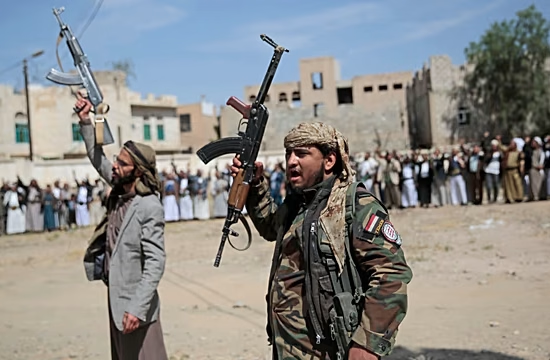
The United Nations has warned that terrorist groups operating in northern Nigeria and the wider Sahel are adopting drones, encrypted communications and cryptocurrencies to strengthen their operations.
Leonardo Santos Simão, the UN special representative for West Africa and the Sahel, raised the alarm during a briefing to the United Nations Security Council.
Simão, who also heads the United Nations Office for West Africa and the Sahel, presented the secretary-general’s latest report on political, security and humanitarian developments in the region. The report covered events between November 29, 2025, and June 30, 2026.
Terrorist groups adopt advanced technology
The UN envoy said armed groups had continued to change their tactics as governments struggled to contain attacks across national borders.
According to him, the groups now use drones, advanced communication systems and cryptocurrencies while coordinating operations across several countries.
He warned that the threat had become particularly severe in the central Sahel and northern Nigeria, where armed groups increasingly combine terrorism with kidnapping, smuggling and other forms of organised crime.
Simão said the groups were attempting to gain territorial and economic control while weakening public trust in government institutions.
Their operations have also damaged social cohesion and created deeper insecurity in communities already struggling with poverty, unemployment and limited access to public services.
The warning reflects growing concern about the technical capabilities of armed groups in the region. Security Council members also highlighted their increasing use of drones, specialised explosive devices and advanced weapons during coordinated attacks.
Nigeria and Sahel countries face persistent attacks
Nigeria, Niger and Burkina Faso continued to record terrorist attacks, abductions and heavy civilian casualties during the period reviewed by the UN.
In Nigeria, insecurity remained especially serious in the northern region, where armed groups have attacked communities, schools and security personnel.
The UN also reported attacks on Niamey airport and a military base in Niger between January and June 2026.
The worsening violence has deepened the region’s humanitarian crisis.
By the end of February, about 6.8 million people had been internally displaced across West Africa and the Sahel. Another 1.28 million people were living as refugees or asylum seekers, including about 220,000 in Benin, Côte d’Ivoire, Ghana and Togo.
Women, children and young people remain among the groups most affected by the crisis. Insecurity, restricted humanitarian access and funding shortages have made it harder for aid organisations to reach vulnerable communities.
UN calls for stronger regional cooperation
Despite the security challenges, Simão said renewed diplomatic efforts were beginning to produce results.
He cited the reopening of the Kamba border crossing between Nigeria and Niger on February 9 as an example of improving regional cooperation. The reopening restored an important trade route between both countries after years of restrictions.
The UN envoy also noted progress by the Cameroon-Nigeria Mixed Commission in implementing the 2002 International Court of Justice judgment covering the land and maritime boundary between both countries.
However, he stressed that countries must strengthen intelligence sharing, border security and joint counterterrorism operations because armed groups operate across national boundaries.
ECOWAS has renewed efforts to make its regional standby force fully operational. The bloc has also called for sustainable funding to support counterterrorism operations and respond more quickly to regional security threats.
Military action alone will not end terrorism
Simão warned governments against relying only on military operations to defeat armed groups.
He said authorities must also tackle poverty, unemployment, poor governance and social exclusion, which extremist organisations often exploit to recruit members and expand their influence.
Investments in education, employment, agriculture and public services would help reduce vulnerability and rebuild public confidence in state institutions.
The Security Council extended UNOWAS’s mandate until January 31, 2029, allowing the office to continue supporting conflict prevention, regional dialogue and democratic governance across West Africa and the Sahel.