
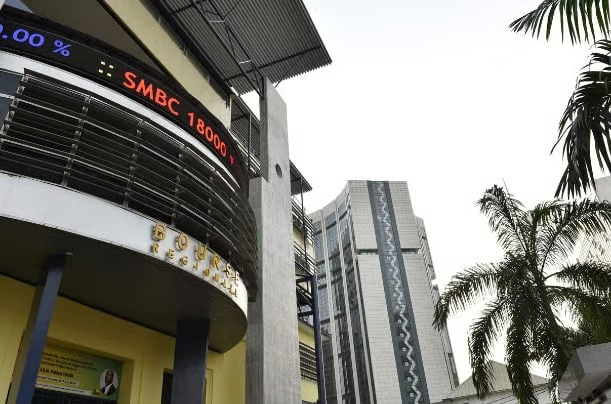
The Bourse de Casablanca and the Bourse Régionale des Valeurs Mobilières (BRVM) are aggressively repositioning themselves as the preferred destinations for foreign capital in Africa, successfully leveraging monetary stability to differentiate themselves from larger, more volatile continental peers. As international fund managers seek to mitigate currency risk in emerging markets, the stock exchanges in Morocco and Côte d’Ivoire have emerged as resilient alternatives to the traditional giants in Lagos and Johannesburg.
For global investors, the primary draw remains the relative predictability of the currencies involved. The Moroccan Dirham is managed against a basket of currencies, while the West African CFA franc used by the eight nations of the Bourse Régionale des Valeurs Mobilières is pegged directly to the Euro. This structural stability provides a hedge against the sharp devaluations that have historically hampered returns on the Nigerian Exchange (NGX) and the Johannesburg Stock Exchange (JSE).
Data from the African Securities Exchanges Association (ASEA) indicates that while total market capitalisation on the continent remains dominated by South Africa, the growth in liquidity and foreign participation in Casablanca and Abidjan has outperformed regional averages over the last 24 months. Morocco, in particular, has benefitted from its status as a gateway to African investment, with the Casablanca Stock Exchange hosting some of the continent’s most robust banking and mining entities, including Attijariwafa Bank and Managem Group.
In West Africa, the BRVM is capitalising on the rapid economic expansion of Côte d’Ivoire and Senegal. The exchange, headquartered in Abidjan, provides access to a unified market of over 110 million people. High-performing stocks such as Sonatel, the Senegalese telecommunications giant, and major regional lenders like Ecobank Transnational Incorporated continue to attract significant institutional interest from Europe and North America.
Monetary Stability and Regulatory Reform Drive Inflows
The shift toward these exchanges is not merely a byproduct of currency trends but the result of deliberate regulatory overhauls designed to increase transparency and ease of entry. The Moroccan Capital Market Authority (AMMC) has introduced new listing tiers for small and medium-sized enterprises (SMEs) and enhanced disclosure requirements to align with international standards. These reforms have boosted investor confidence, leading to a more diversified investor base that includes a higher percentage of long-term pension funds and sovereign wealth funds.
Furthermore, the integration of these markets into global indices has played a critical role. Morocco’s reclassification within the MSCI indices and the inclusion of key BRVM stocks in frontier market funds have forced passive investment flows into these markets. This institutional demand has created a virtuous cycle of liquidity, making it easier for large-scale investors to enter and exit positions without triggering extreme price volatility.
Infrastructure developments are also playing a part. Both exchanges have invested heavily in digitising their trading platforms and clearing systems. The implementation of the African Exchanges Linkage Project (AELP), a flagship initiative by ASEA and the African Development Bank, is further facilitating cross-border trading. This allows an investor in Casablanca to more easily purchase shares in Abidjan or Nairobi, effectively creating a more cohesive continental capital market that can compete with other emerging regions like Southeast Asia or Eastern Europe.
However, challenges remain. Despite the growth, the number of new initial public offerings (IPOs) has been slow to match the increase in secondary market activity. Both the Moroccan and West African authorities are currently working on incentive programmes to encourage private companies, particularly in the technology and renewable energy sectors, to list. The goal is to move beyond the traditional dominance of banks and telecommunications firms to offer a broader sectoral mix to foreign investors.
The competitive landscape is also shifting as other regional hubs attempt to replicate this success. The Egyptian Exchange and the Nairobi Securities Exchange have also introduced reforms to lure back foreign capital following periods of domestic economic adjustment. Nevertheless, the combination of political stability in Morocco and the currency peg in the WAEMU region provides Casablanca and Abidjan with a unique defensive profile that is currently resonating with risk-averse international managers.
As we move into the final quarter of the year, market analysts expect a further surge in activity as several state-owned enterprises in Côte d’Ivoire and Morocco prepare for partial privatisations through the stock exchange. These primary market events are viewed as essential tests for the depth of these markets and their ability to absorb large-scale foreign institutional orders. The success of these upcoming listings will likely determine whether the current trend of capital inflow becomes a permanent shift in Africa’s financial geography.
Explore more Money stories and analysis from Business Elites Africa.


