
Djibouti is navigating its most precarious diplomatic and economic period in decades as Houthi rebels in Yemen extend their reach toward the Bab el-Mandeb strait, a chokepoint through which approximately 12% of global trade passes. For the small East African nation, the escalating maritime conflict is not merely a security concern but a direct threat to the port-driven economic model that sustains its national budget.
The country’s economy is almost entirely dependent on its strategic location at the entrance to the Red Sea. Recent data from the World Bank indicates that services, primarily port-related activities, account for more than 70% of Djibouti’s Gross Domestic Product (GDP). Any prolonged disruption to shipping lanes or a shift in Djibouti’s neutrality could jeopardise the revenue streams that service its significant external debt.
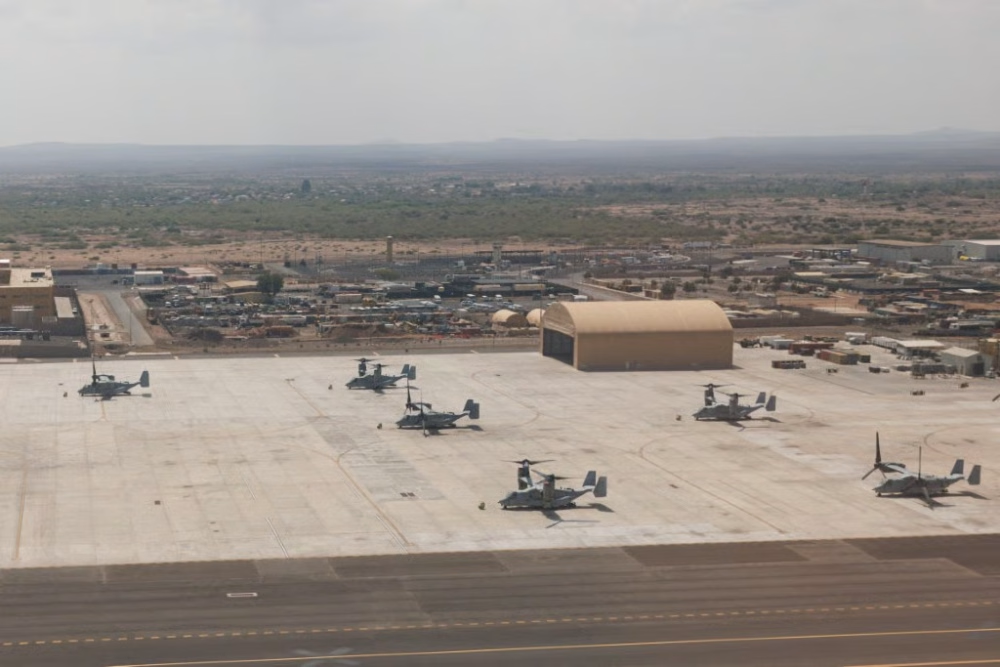
As Houthis move closer to the coastal borders, the pressure on Djibouti to take a definitive side has intensified. Currently, the nation hosts an unusual collection of foreign military bases, including those of the United States, China, France, Japan, and Italy. These bases provide Djibouti with over $120 million in annual rent, but they also place the country at the centre of a global geopolitical tug-of-war over the safety of the Suez Canal route.
The primary commercial risk involves the Doraleh Multipurpose Port and the SGTD container terminal. Since Houthi attacks on commercial vessels began in late 2023, many global shipping giants have diverted traffic around the Cape of Good Hope. While Djibouti has remained a vital hub for regional cargo, particularly for landlocked Ethiopia, the broader decline in Red Sea transit volume threatens to reduce the transshipment fees that the Djibouti Ports and Free Zones Authority (DPFZA) relies on for infrastructure expansion.
Port Infrastructure and Maritime Trade Vulnerabilities
Djibouti’s relationship with Ethiopia remains the cornerstone of its commercial stability. Approximately 90% of Ethiopia’s maritime trade passes through Djibouti’s ports, connected by the Chinese-funded Addis Ababa-Djibouti Railway. While this bilateral trade remains relatively insulated from Red Sea shipping diversions, any spillover of the Yemen conflict into Djibouti’s territorial waters could force insurance premiums to prohibitive levels, effectively bottlenecking Ethiopia’s only reliable trade corridor.
Financial analysts are monitoring the impact of the conflict on Djibouti’s debt sustainability. The International Monetary Fund (IMF) has previously flagged Djibouti’s high risk of debt distress, largely due to the $1.6 billion in loans from China used to build the railway and port infrastructure. If port revenues stagnate because of regional instability, Djibouti may find it increasingly difficult to meet its repayment obligations, potentially requiring another round of complex debt restructuring with Beijing.
The government in Djibouti has so far maintained a strict policy of non-interference, refusing to join the US-led Operation Prosperity Guardian. This stance is intended to protect the country from becoming a direct target for Houthi strikes. However, the proximity of Houthi drones and missiles to the Bab el-Mandeb strait makes the “business as usual” approach difficult to sustain as shipping companies weigh the risks of docking at East African terminals.
Despite these challenges, Djibouti is continuing with its long-term Vision 2035 economic plan, which seeks to transform the country into a regional logistics and financial hub. The government recently inaugurated the Damerjog Industrial Development, a massive petrochemical and logistics complex. The success of such projects depends heavily on the perception of Djibouti as a safe haven in a volatile region.
Market observers suggest that if the conflict persists, Djibouti may be forced to enhance its own maritime security capabilities or allow greater foreign naval intervention within its waters to reassure commercial operators. For now, the nation remains in a holding pattern, balancing its role as a global military landlord with its necessity as a commercial gateway. The coming months will determine whether Djibouti can successfully insulate its economy from the fires across the water or if the Red Sea’s instability will finally breach its shores.
Explore more News stories and analysis from Business Elites Africa.


