
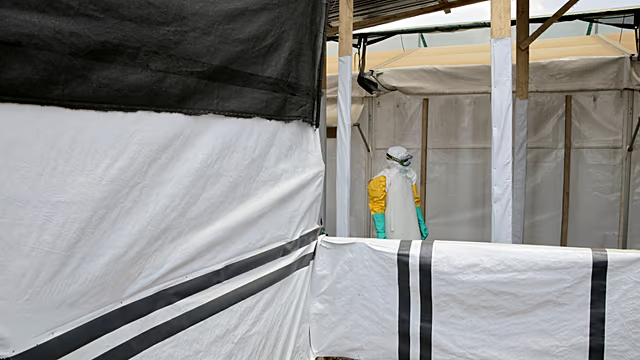
Health authorities in the Democratic Republic of Congo (DRC) have confirmed that the country’s ongoing Ebola outbreak has exceeded 7,000 cases, marking the most severe epidemiological crisis in the region’s recent history. The Ministry of Health disclosed on Saturday that the death toll has now reached nearly 3,400 since the first cases were identified in this latest wave.
Despite the high number of infections, government officials expressed a cautious optimism, stating that the rate of transmission appears to be slowing. Data released by the national biomedical research institute suggests that the spread of the virus may have peaked, following an aggressive month-long intervention involving international medical teams and expanded vaccination coverage.
The outbreak has placed an immense strain on the DRC’s public health infrastructure and fiscal reserves. Since the surge began, the government has been forced to reallocate significant portions of its national budget toward emergency response units, treatment centres, and border surveillance. This fiscal shift has delayed several planned infrastructure projects in the eastern provinces, where the virus has been most prevalent.
International response efforts have been led by the World Health Organisation (WHO), which has deployed specialists to assist with contact tracing and the distribution of the latest generation of Ebola vaccines. While the 7,000-case milestone highlights the scale of the challenge, health experts note that the proportion of recoveries has increased significantly compared to outbreaks in previous decades.
Financial markets and regional trade observers have closely monitored the situation due to the DRC’s critical role in the global minerals supply chain. The eastern regions, frequently affected by such health emergencies, are also hubs for artisanal and industrial mining. Disruptions to labour availability and the imposition of travel restrictions have previously slowed the movement of goods toward the ports of East Africa.
Economic Impact and Mining Sector Resilience
The commercial consequences of the 7,000-case milestone are felt most acutely in the logistics and mining sectors. Major mining houses operating in the DRC have had to implement stringent health protocols to protect their workforce and ensure continuity of operations. These measures include mandatory thermal screening, regular health checks for staff, and restricted access to mine sites for non-essential personnel.
According to reports from the World Bank, the economic cost of containing such an outbreak often extends beyond direct medical expenses. For the DRC, the indirect costs include reduced cross-border trade with Rwanda and Uganda, as well as a temporary decline in investor confidence regarding the stability of the local labour market. However, the mining sector has largely remained operational, buoyed by high global demand for transition metals like cobalt and copper.
The government’s claim that the outbreak has peaked is supported by a week-on-week decline in new confirmed cases in the primary hotspots of North Kivu and Ituri. Health officials attribute this to a more effective community engagement strategy, which has helped overcome local resistance to medical interventions and safe burial practices. This shift in community trust is seen as a pivotal factor in bringing the reproductive rate of the virus below the critical threshold.
Public finance analysts suggest that if the peak has indeed passed, the DRC government may be able to begin tapering emergency spending by the final quarter of the year. The National Assembly is expected to review a supplementary budget next month to address the deficit created by the health crisis. Current estimates suggest the government has spent over $450 million on the response effort, excluding international aid contributions.
The regional response has also involved the Africa Centres for Disease Control and Prevention (Africa CDC), which has worked to harmonise travel requirements across the Great Lakes region. These efforts aim to prevent a total shutdown of economic corridors, which would have devastating effects on small and medium-sized enterprises (SMEs) that rely on the daily movement of people and products across borders.
As the DRC looks toward the recovery phase, the focus is shifting toward strengthening the primary healthcare system to prevent future resurgences. The Ministry of Health has indicated that the next phase of the response will involve a long-term surveillance programme and the establishment of permanent isolation wards in high-risk zones. The success of these plans depends on continued funding from international partners and the stability of the security situation in the eastern provinces.
Government technicians are expected to release a detailed epidemiological report by the end of the month. This document will provide a clearer picture of the infection clusters and the effectiveness of the vaccination campaign. For now, the priority remains the treatment of existing patients and the completion of contact tracing in areas where the virus was most recently detected.
Explore more News stories and analysis from Business Elites Africa.


