
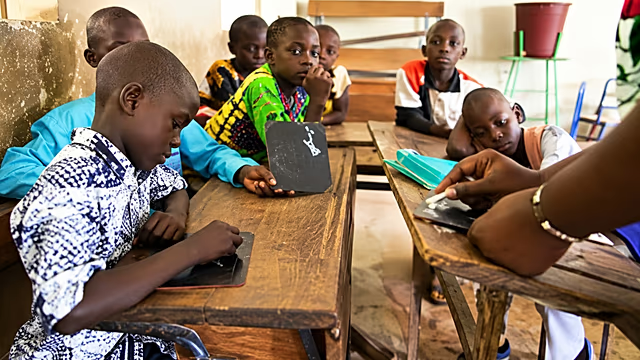
More than 2,400 schools across Mali remain shuttered as the country officially commences its 2026-2027 academic year, according to latest government figures and monitoring reports. The mass closures underscore a persistent security crisis that is increasingly viewed by economists as a long-term threat to the nation’s human capital and future industrial productivity.
While the Malian transition government has publicly maintained that education is a national priority, the reality on the ground in the northern and central regions remains fraught with risk. Non-state armed groups continue to target educational institutions, viewing them as symbols of state authority or ideological opposition. This has forced thousands of teachers to flee and left hundreds of thousands of children without access to formal instruction.
The scale of the disruption is significant for a country attempting to diversify its economy beyond artisanal mining and subsistence agriculture. According to data tracked by UNICEF Mali, school closures have trended upward over the last three years, moving from approximately 1,700 in 2023 to the current figure exceeding 2,400. This trajectory suggests that despite increased military operations, the state’s ability to secure social infrastructure remains severely compromised.
For the Malian business community and potential foreign investors, the education gap represents a structural risk. The inability to educate a significant portion of the youth population in conflict-affected zones like Mopti, Gao, and Menaka creates a vacuum in the future labour market. A lack of basic literacy and technical skills among the youth often correlates with higher recruitment rates into informal economies or extremist groups, further destabilising the regional investment climate.
Security Budgets Straining Social Sector Investment
The financial cost of the insecurity is also being felt in the national budget. Mali’s fiscal policy has shifted heavily toward defence and internal security spending, often at the expense of social sectors. The World Bank has previously noted that the rising cost of conflict in the Sahel limits the fiscal space available for critical investments in infrastructure and education, which are necessary for sustainable GDP growth.
In the current budget cycle, a substantial portion of the capital expenditure originally earmarked for school renovations and teacher training has been diverted to support the frontline operations of the Malian Armed Forces (FAMa). While the government argues that security is the prerequisite for all other development, the prolonged absence of state-funded education in vast swathes of the country risks creating a “lost generation” that will be unable to contribute to the formal economy for decades.
The private education sector is also feeling the pinch. In urban centres such as Bamako, private schools have seen a surge in enrolments as displaced families move southward. However, this has led to overcrowded facilities and a decline in the quality of instruction. Conversely, private educational enterprises in the north have largely ceased operations, facing total capital loss as buildings are either destroyed or abandoned due to the threat of kidnapping and targeted attacks on staff.
The impact extends to Mali’s regional standing within the Alliance of Sahel States (AES). Along with neighbours Burkina Faso and Niger, Mali is grappling with a shared security architecture that seeks to decouple the region from traditional Western partnerships. However, the economic success of this new alignment depends heavily on internal stability and the development of local capacity. Without a functional education system, the transition from a resource-dependent economy to a more diversified industrial base remains a distant prospect.
International aid organisations continue to lobby for the establishment of “protected education zones,” but these initiatives have met with limited success given the fluid nature of the conflict. The government has attempted to implement distance learning programmes and radio-based instruction, but limited electricity and internet penetration in rural Mali mean these measures reach only a fraction of the affected student population.
Looking ahead, the Malian Ministry of Education has indicated it will attempt a phased reopening of schools in areas recently reclaimed by the military. However, the lack of a clear timeline for the return of civil servants and the persistent threat of improvised explosive devices (IEDs) on major supply routes suggest that the reopening process will be slow and precarious. For now, the closure of over 2,400 schools remains a sobering indicator of the hurdles facing Mali’s path to economic recovery.
Explore more News stories and analysis from Business Elites Africa.


