
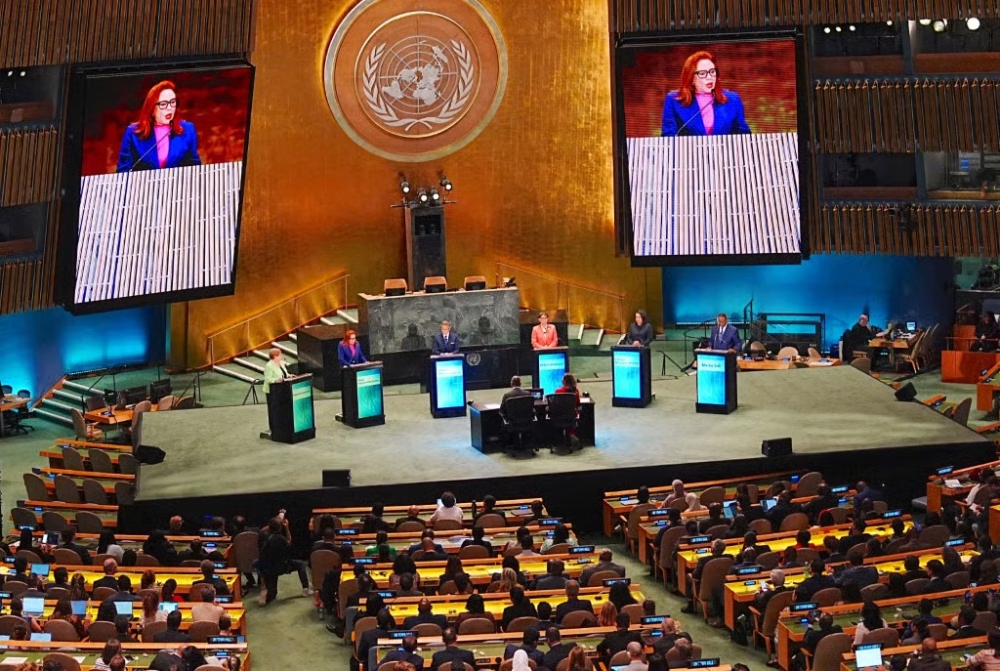
María Fernanda Espinosa Says UN Reform Cannot Succeed While Africa Is Marginalised
María Fernanda Espinosa, a candidate to become the next Secretary-General of the United Nations, has put Africa’s representation at the centre of the debate over how the 80-year-old institution should be rebuilt.
Espinosa, a former president of the UN General Assembly and former foreign minister of Ecuador, argues that the organisation cannot restore its credibility while large parts of the world remain underrepresented in the institutions where its most consequential decisions are made.
Her position comes as the UN faces mounting pressure over its inability to prevent major conflicts, severe funding constraints and a governance structure that still largely reflects the balance of power that existed after the Second World War.
In an August interview with the BBC World Service, Espinosa warned that the UN risks becoming irrelevant unless it changes how it operates. Her description of the choice facing the institution was stark: “reform, transform or die.”
For Africa, that debate has particular significance.
Despite accounting for 54 UN member states and a substantial share of the organisation’s peace and security agenda, no African country holds a permanent seat on the UN Security Council.
That is the imbalance African governments have spent more than two decades trying to change.
Africa wants more than symbolic representation
The African Union’s Common African Position, set out through the Ezulwini Consensus and Sirte Declaration, calls for Africa to receive at least two permanent Security Council seats, with the same privileges enjoyed by existing permanent members, including veto rights for as long as the veto remains.
It also demands five non-permanent seats for African countries.
The AU argues that anything less would leave the fundamental imbalance in global decision-making intact.
In May, African Union Commission Chairperson Mahmoud Ali Youssouf described permanent African representation as the correction of a “historical injustice”, rather than a concession that the continent should have to negotiate for.
His argument captures the political problem confronting whoever becomes the next UN Secretary-General. A Security Council designed around the geopolitical realities of 1945 is increasingly being asked to manage conflicts, demographic shifts, climate risks and economic tensions in a world that looks substantially different.
Espinosa has positioned herself as an advocate for changing that system.
During her formal dialogue with UN member states in June, the African Group pressed her directly on whether she supported the continent’s demands for Security Council reform.
Representing the African Group, Malawi described Africa’s exclusion from permanent membership as both a historical injustice and a structural inequality affecting decisions on issues central to the continent.
Espinosa acknowledged the long-running Security Council reform process and said the Secretary-General should provide impartial institutional support to help negotiations advance, while improving the Council’s effectiveness and working methods.
That answer reflects an important limitation of the job she is seeking.
A Secretary-General cannot simply award Africa permanent Security Council seats. Reform ultimately requires agreement among UN member states and would involve changes to the institutional structure protected by some of the world’s most powerful countries.
But the Secretary-General can use the office’s political authority to keep reform on the agenda, build coalitions and increase the cost of allowing negotiations to remain permanently stalled.
Africa’s argument extends beyond the Security Council
Representation is only one element of Africa’s challenge with the international system.
During Espinosa’s UN dialogue, the African Group also raised questions about African representation in international financial institutions, access to climate finance, funding for African development programmes and the relatively small number of Africans occupying senior positions within the UN system.
These issues point to a broader argument about power.
African states are frequently central to discussions about peacekeeping, climate change, humanitarian intervention, debt and development. But African governments have long argued that the continent does not possess equivalent influence over the institutions that set the rules governing those issues.
The UN Security Council offers the most visible example.
Its five permanent members, China, France, Russia, the United Kingdom and the United States, retain veto power over some of the world’s most consequential security decisions. None is African.
The African Union has therefore resisted reform proposals that merely increase temporary African representation while leaving permanent decision-making power untouched.
Its 2026 reform model explicitly states that Africa should receive no fewer than two permanent seats and five non-permanent seats. The model was submitted as negotiations over Security Council reform continued at the General Assembly this year.
Espinosa is campaigning to lead a UN under pressure
Espinosa was formally nominated for Secretary-General by Antigua and Barbuda in May 2026.
Her résumé includes serving as president of the 73rd session of the UN General Assembly, as Ecuador’s foreign minister and defence minister, and as the country’s representative to the United Nations.
She is also campaigning at an unusually difficult moment for the institution.
The UN faces financial pressure, declining humanitarian resources and questions about why it has struggled to influence some of the conflicts dominating international politics.
Espinosa argues that the problem cannot be solved through administrative tinkering alone.
In her BBC interview, she said the UN still has an indispensable purpose but needs to adapt to realities very different from those that existed when its Charter was written. She argued that the institution should judge itself more by measurable outcomes, including the lives it saves, the conflicts it prevents and the people it helps escape poverty.
She has also warned that the UN increasingly risks being absent from negotiations where it should matter most.
That is why Africa’s representation question has consequences beyond the continent itself.
A multilateral institution derives much of its authority from whether governments believe its rules and decision-making structures are legitimate. Leaving an entire continent outside permanent membership of its most powerful body makes that legitimacy increasingly difficult to defend.
Earlier this month, Espinosa met African Union Commission Chairperson Mahmoud Ali Youssouf, with both sides discussing the future of multilateralism, the AU-UN partnership and the need for African priorities to be properly reflected in the United Nations.
The political challenge now is converting that growing acknowledgement into institutional change.
For decades, governments have broadly agreed that the Security Council does not adequately represent today’s world. Agreement on precisely who should receive new permanent seats, whether veto power should expand and how large an enlarged Council should become has proved far harder.
That stalemate is increasingly part of the UN’s credibility problem.
If the next Secretary-General is expected to make the organisation more representative, effective and relevant, Africa will be one of the clearest tests of whether reform means redistributing actual power or merely changing the language around it.
Explore more Business stories and analysis from Business Elites Africa.


