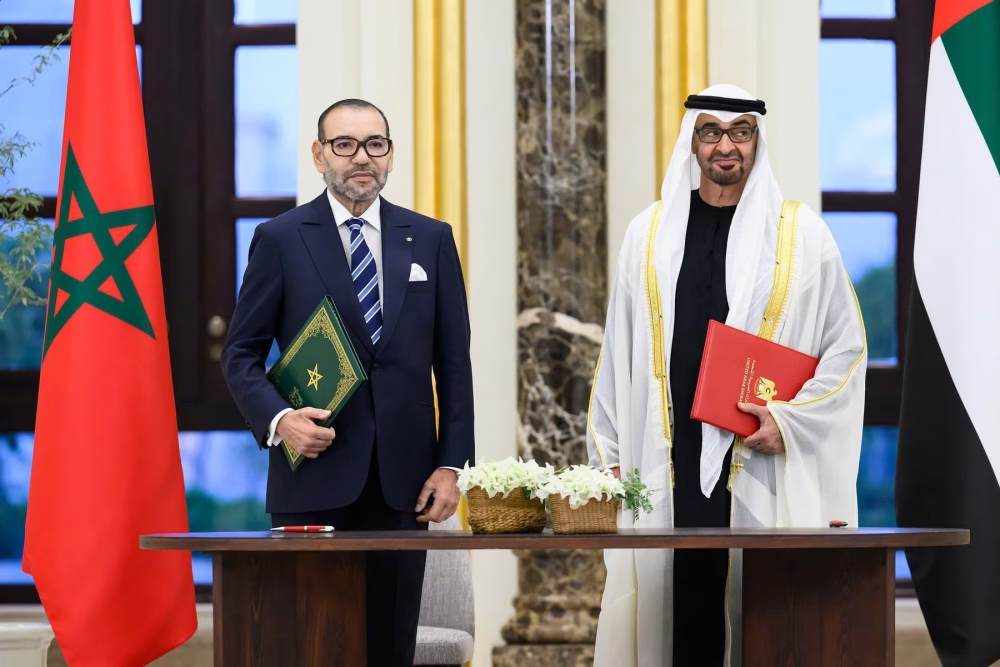
Morocco and the United Arab Emirates are constructing a strategic economic and geopolitical corridor, termed the Atlantic-to-Gulf axis, to integrate Gulf capital with West African market access through massive investments in energy, logistics, and infrastructure.
The partnership has evolved beyond traditional bilateral trade into a structured alliance between two monarchies seeking to diversify their economic dependencies. For Abu Dhabi, Morocco serves as a stable, high-growth gateway into the African continent. For Rabat, the UAE provides the financial liquidity and technical expertise required to execute King Mohammed VI’s ambitious plan to transform Morocco into a logistical hub for the Sahel region.
The Atlantic Initiative and Sahel Integration
Central to this alliance is the Moroccan Atlantic Initiative, a strategic project designed to provide landlocked Sahelian countries—including Mali, Niger, Burkina Faso, and Chad—access to the Atlantic Ocean. By offering these nations the use of Moroccan port infrastructure, Rabat aims to foster economic integration and provide a commercial alternative to the volatile corridors currently used by these states.
The UAE is playing a critical role in the financing and operational scaling of this vision. Through sovereign wealth funds and state-backed enterprises, the UAE is investing in the transport and logistics networks that will connect the Atlantic coast to the interior of West Africa. This alignment allows Abu Dhabi to extend its economic footprint deep into the African interior, leveraging Morocco’s diplomatic ties and territorial stability.
The strategic logic is clear: the UAE seeks to secure supply chains and create new markets for its diversified portfolio, while Morocco enhances its role as a regional hegemon by becoming the indispensable gateway for West African trade.
Energy Transition and Green Hydrogen
Energy is the primary engine of the Morocco-UAE axis. Both nations are aggressively pursuing a transition away from fossil fuel dependency, though their starting points differ. The UAE is leveraging its oil wealth to lead in renewables, while Morocco is utilizing its natural geography to become a global leader in green energy.
The UAE’s Masdar, a global leader in renewable energy, has been a primary vehicle for this cooperation. Masdar has invested heavily in Morocco’s wind and solar sectors, contributing to the development of the Masdar-led projects that complement Morocco’s Noor Ouarzazate Solar Complex, one of the largest concentrated solar power plants in the world.
Current cooperation is shifting toward green hydrogen. Morocco possesses some of the lowest production costs for green hydrogen globally due to its abundant wind and solar resources. The UAE is eyeing this capacity not only for investment but as a potential source of energy imports to support its own net-zero targets. This creates a symbiotic relationship where Moroccan land and nature provide the raw energy capacity, and UAE capital provides the industrial scale.
Logistics and the DP World Connection
The logistical dimension of the alliance is anchored by DP World, the Dubai-based port operator. The UAE’s strategy in Africa has shifted from fragmented investments to the creation of integrated trade corridors. In Morocco, this manifests as a synergy between the UAE’s port management expertise and Morocco’s Tanger Med, one of the most competitive ports in the Mediterranean and Atlantic.
The coordination between Rabat and Abu Dhabi focuses on optimizing the flow of goods from the Gulf, through the Strait of Gibraltar, and down the Atlantic coast toward West African markets. This connectivity reduces transit times and lowers costs for UAE-based firms exporting manufactured goods and services to Africa.
Beyond ports, the two nations are expanding cooperation in aviation and tourism. The UAE’s investment in Moroccan hospitality and infrastructure is intended to position the kingdom as a premier destination for Gulf tourists and a corporate base for UAE firms operating in the Maghreb.
Financial Symmetry and Sovereign Wealth
The relationship is underpinned by a high degree of political and financial symmetry. Both nations are led by monarchies that exercise strong centralized control over strategic economic planning, allowing for the rapid execution of multi-billion dollar projects without the delays often associated with democratic legislative cycles.
This structural alignment has facilitated the movement of capital through sovereign wealth funds. UAE investors are increasingly viewing Moroccan assets as “safe havens” within Africa, offering a combination of legal protections, strategic location, and pro-business regulation. Moroccan financial institutions are simultaneously looking toward the Gulf to secure funding for large-scale infrastructure projects that the domestic budget cannot fully sustain.
The alliance also extends to the banking sector, with UAE-based financial institutions exploring partnerships with Moroccan banks to facilitate trade finance for companies operating along the Atlantic-to-Gulf corridor.
Comparing the GCC Shift in Africa
Historically, Gulf investment in Africa was concentrated in East Africa, with significant focus on Ethiopia, Kenya, and Rwanda. However, the Morocco-UAE axis represents a strategic pivot toward the North and West. This shift is driven by several factors:
- Political Stability: Morocco offers a more predictable political environment than some of the volatile regimes in East Africa.
- Regulatory Alignment: Morocco’s ongoing reforms to attract FDI align well with the UAE’s requirements for transparency and efficiency.
- Market Access: The Atlantic coast provides a more direct route to the growing markets of West Africa, including Nigeria and Ghana.
By anchoring its African strategy in Rabat, the UAE is not just investing in a single country but is purchasing a strategic position on the Atlantic coast, balancing its existing interests in the Indian Ocean.
Material Consequences and Next Steps
The practical consequence of this axis is a reconfiguration of trade flows in West Africa. As Morocco builds out the infrastructure for the Atlantic Initiative, the dependence of Sahelian states on traditional routes may decrease, shifting the economic gravity toward Rabat.
For investors, this partnership signals a reduction in the perceived risk of West African infrastructure projects, provided they are backed by the Morocco-UAE framework. The next phase of the alliance is expected to focus on the digitization of trade—implementing blockchain and AI-driven logistics to streamline the movement of goods from Abu Dhabi to the Atlantic coast.
Furthermore, the two nations are likely to deepen their cooperation in defense and security, as the economic integration of the Sahel requires a stable security environment to protect the projected investments in roads, railways, and energy pipelines.
The success of the Atlantic-to-Gulf axis will ultimately depend on the ability of Morocco to maintain diplomatic stability with its Sahelian neighbors and the UAE’s continued willingness to deploy capital in a region facing significant security challenges. However, the current trajectory suggests a long-term structural realignment that will make Morocco the primary bridge between the Gulf’s wealth and Africa’s Atlantic potential.
Explore more Insight & Analysis stories and analysis from Business Elites Africa.