
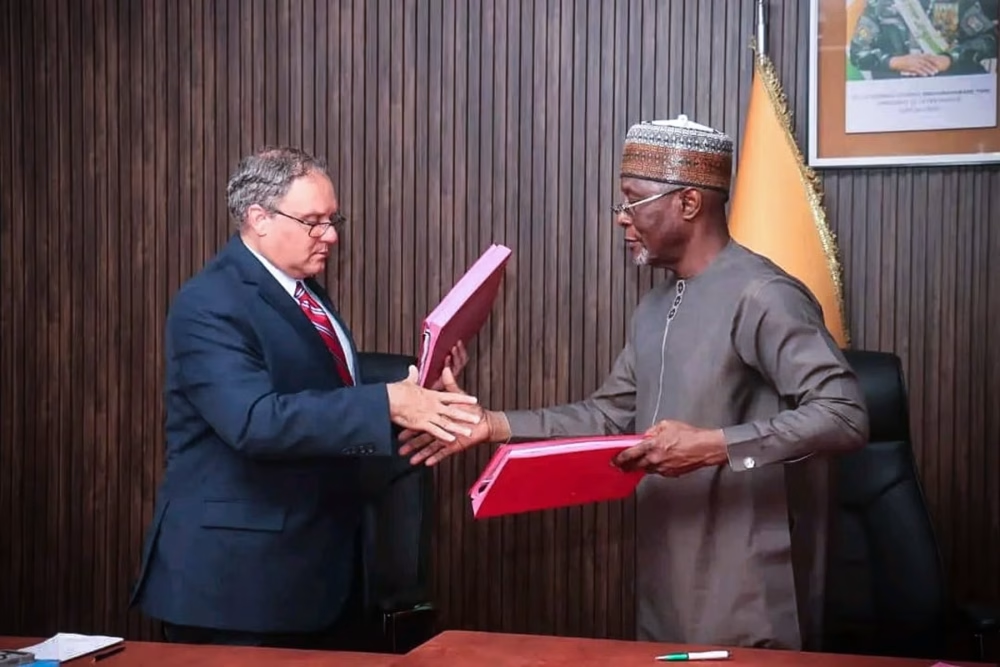
The government of Niger has entered into a $1.9 billion agreement with Zimar, a Canadian-based group, to develop a new oil refinery in Dosso, a move that has triggered significant scrutiny over the partner’s industry experience.
The deal, which aims to bolster the landlocked nation’s energy security, has raised alarms among observers and even within certain circles of the Nigerien government. At the centre of the controversy is the lack of a verifiable track record for Zimar in managing large-scale, complex oil and gas infrastructure projects.
While the project promises to transform Niger’s energy landscape by reducing its reliance on imported refined petroleum products, the selection of a partner with limited institutional history is being viewed as a high-stakes gamble for the state’s public finances.
According to reporting by The Africa Report, the skepticism regarding Zimar’s capability is not limited to external analysts but has also surfaced internally within the government. The concerns primarily focus on whether a firm without documented success in refinery construction can successfully execute a project of this magnitude and technical complexity.
Concerns Grow Over Project Viability and Zimar’s Expertise
For Niger, the establishment of a domestic refinery in Dosso is a strategic priority. The country has long sought to mitigate the economic volatility caused by fluctuating fuel prices and the logistical challenges of transporting refined products across borders. A local refinery could provide a more stable supply of diesel, petrol, and other essential petroleum products, supporting both industrial growth and domestic consumption.
However, the $1.9 billion investment required for the project represents a substantial portion of Niger’s economic capacity. Given the country’s recent political and economic shifts, the management of such significant capital is under intense scrutiny. Financial analysts suggest that entering into long-term, high-value infrastructure agreements with unproven entities increases the risk of project delays, cost overruns, and ultimately, failed delivery.
In the broader context of African energy infrastructure, many large-scale projects have struggled due to a combination of technical mismanagement and opaque procurement processes. As the World Bank notes regarding Niger’s economic landscape suggest, fiscal stability remains a critical factor for the nation’s development goals. A failure in the Dosso refinery project could have cascading effects on the national budget and investor confidence in the country’s ability to host major industrial developments.
The selection of Zimar also raises questions regarding the transparency of the procurement process used by the Nigerien authorities. In many emerging markets, the sudden emergence of foreign firms with little to no local or regional presence for massive infrastructure projects often leads to calls for more rigorous due diligence and competitive bidding.
The technical requirements for a modern refinery are immense, involving sophisticated supply chain management, advanced engineering, and strict adherence to environmental and safety regulations. Industry experts suggest that for a project in Dosso to be successful, the lead contractor must demonstrate not only financial liquidity but also a deep reservoir of technical expertise and a proven ability to manage multi-year construction cycles in challenging environments.
As the agreement moves toward the implementation phase, the Nigerien government will face increasing pressure to provide clarity on the oversight mechanisms in place to protect the state’s interests. The ability of the authorities to monitor Zimar’s progress and enforce contractual obligations will be decisive in determining whether the $1.9 billion investment results in a functional energy hub or becomes a significant stranded asset.
The next critical stage for the project will involve the commencement of detailed engineering designs and the finalisation of the financing structure. Stakeholders will be watching closely to see if Zimar can secure the necessary technical partnerships or sub-contractors required to bridge its apparent experience gap.
Explore more Oil & Gas stories and analysis from Business Elites Africa.


