
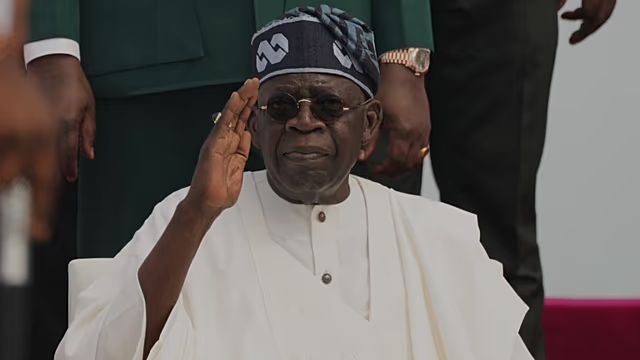
Nigeria has confirmed the planned withdrawal of approximately 200 United States troops previously deployed to assist the West African nation in managing its complex and enduring security crisis.
The confirmation comes as part of a strategic adjustment in military cooperation between Abuja and Washington. The US personnel were primarily involved in advisory roles, intelligence sharing, and providing technical support to the Nigerian Armed Forces.
The move was reported by Africanews, noting that the withdrawal is a planned transition rather than a sudden rupture in diplomatic ties.
The US presence in Nigeria has focused heavily on combating the insurgency of Boko Haram and the Islamic State West Africa Province (ISWAP) in the North-East, alongside addressing the rise of banditry and kidnapping in the North-West.
The deployed troops operated under the guidance of the US Africa Command (AFRICOM), which has sought to shift its operational model in the region toward a “light footprint” approach. This strategy emphasises training and capacity building over direct troop presence.
For several years, the US provided critical intelligence, surveillance, and reconnaissance (ISR) capabilities, including the use of unmanned aerial vehicles (drones) to track militant movements in the Sambisa Forest and Lake Chad basin.
Security Transitions and Investment Risk
The withdrawal occurs at a time when security remains a primary determinant for foreign direct investment (FDI) in Nigeria. Persistent instability in the hinterlands has historically disrupted agricultural supply chains and mining operations, impacting the country’s non-oil GDP growth.
Investors often view the presence of international security partners as a stabilizing factor. The departure of US personnel may raise questions about the current trajectory of Nigeria’s internal security capabilities and its ability to maintain territorial control without external tactical support.
However, the Nigerian government has increasingly diversified its security partnerships. In recent years, Abuja has expanded its procurement of military hardware and intelligence systems from Turkey and China to reduce reliance on any single Western partner.
The shift reflects a broader trend across the Sahel and West Africa, where several nations have requested the departure of foreign military forces to assert greater sovereign control over their security architectures.
Analysts suggest that the efficacy of this withdrawal will depend on whether the US maintains its high-level intelligence sharing and drone surveillance capabilities remotely, or if those assets are also being scaled back.
The US Department of Defense has previously stated that its goal in Africa is to empower local forces to lead their own security operations while providing the necessary tools and training for sustainability.
From a commercial perspective, the continued volatility of the security environment remains the largest risk premium for companies operating in the energy and infrastructure sectors, where physical assets are vulnerable to attack.
The Nigerian military is expected to announce revised operational strategies to fill the gap left by the departing US advisors, potentially increasing the reliance on indigenous intelligence networks and local paramilitary forces.
The government has not yet provided a specific timeline for the final departure of all 200 troops, nor has it disclosed the exact nature of the revised bilateral security agreement that will govern future US-Nigeria cooperation.
Explore more News stories and analysis from Business Elites Africa.


