
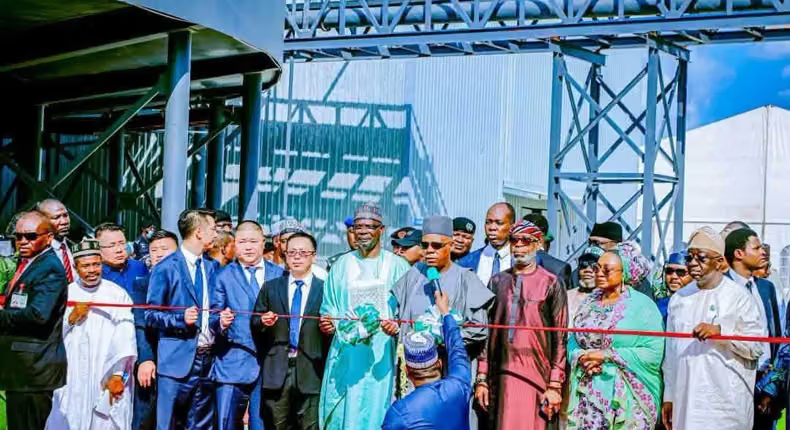
Nigeria has commissioned what the Federal Government describes as West Africa’s largest lithium processing plant, marking a major step in the country’s plan to move from raw mineral exports to local processing and battery-related manufacturing.
The facility, located in the Endo community of Nasarawa State, can process 6,000 metric tonnes of lithium daily and up to three million metric tonnes annually.
For Nigeria, the project is more than a mining investment. It is part of a wider strategy to build value around critical minerals as demand rises for electric vehicles, solar power systems, rechargeable batteries and clean energy technologies.
Why It Matters
- Nigeria has commissioned West Africa’s largest lithium processing plant in Nasarawa State.
- The facility has a daily processing capacity of 6,000 metric tonnes.
- It can process up to three million metric tonnes of lithium every year.
- The project has created over 1,000 direct jobs and more than 2,000 indirect jobs.
- Nigeria wants to stop exporting raw minerals without adding value locally.
Nigeria Moves From Raw Minerals to Processing
For years, many African countries have exported raw minerals while other regions captured most of the value through processing, manufacturing and technology production.
Nigeria now wants to change that pattern.
President Bola Tinubu, represented by Vice President Kashim Shettima at the inauguration, said natural resources alone cannot create wealth unless they are backed by vision, institutions, industry and people.
His message was clear: Nigeria must move beyond digging minerals out of the ground and exporting them in raw form.
The government wants more minerals processed locally so the country can create jobs, attract factories and build stronger industrial supply chains.
Why the Nasarawa Lithium Plant Matters
The new lithium processing facility gives Nigeria a stronger position in the fast-growing global battery supply chain.
Lithium is one of the most important minerals in the world today because it is used in rechargeable batteries. These batteries power electric vehicles, smartphones, energy storage systems, solar equipment and other clean energy technologies.
As global demand for cleaner energy grows, countries with lithium reserves are trying to capture more value from the mineral.
Nigeria does not want to remain only a supplier of raw lithium ore. The government wants the country to process lithium, attract battery-related industries and eventually support local manufacturing of products that depend on lithium.
Jobs and Local Economic Impact
The company operating the facility said the project has already created more than 1,000 direct jobs and over 2,000 indirect jobs.
This is important for Nasarawa State and Nigeria’s wider mining sector.
Beyond mining workers, projects like this can support transport companies, equipment suppliers, engineers, technicians, local businesses and service providers.
If properly managed, the lithium plant could also encourage more investment in roads, power, storage facilities and other infrastructure needed to support industrial activity.
Africa Is Racing to Process Its Minerals Locally
Nigeria’s move comes at a time when many African countries are pushing to stop the export of unprocessed minerals.
Zimbabwe has already banned the export of unprocessed lithium. Namibia has also introduced restrictions on the export of some unprocessed critical minerals.
The Democratic Republic of Congo and Zambia have been working on plans to build battery value chains around their large copper and cobalt reserves.
This shows a major shift across Africa.
Governments no longer want their countries to remain at the bottom of the global mineral value chain. They want processing plants, battery factories, component manufacturing and stronger industrial ecosystems.
Nigeria Doubles Down on Critical Minerals
The lithium plant also comes shortly after Nigeria announced the discovery of what officials described as a world-class polymetallic mineral province in Kaduna State.
The discovery reportedly contains platinum group metals, gold, nickel, copper, lithium and rare earth elements.
Minister of Solid Minerals Development, Dele Alake, said the new lithium project supports the government’s policy of local value addition.
He said Nigeria would no longer encourage the export of raw minerals without local processing.
According to him, the government’s ambition is to produce lithium batteries, electric vehicles, phones, solar panels, solar-powered turbines and other products that depend on lithium.
That is an ambitious goal, but the new processing plant is one of the first steps toward that direction.
Chinese Investment Expands in Nigeria’s Mining Sector
The project also shows the growing role of Chinese companies in Africa’s critical minerals industry.
Diamond New Energy, the company behind the facility, said it is investing not only in mining but also in processing, infrastructure, workforce development and partnerships with local communities.
The company’s representative, Yu Chongqiang, said the long-term goal is to build an integrated industrial platform that supports local manufacturing, strengthens supply chains and contributes to Africa’s clean energy future.
Chinese investment has become increasingly important in Africa’s mining and energy sectors, especially as global competition for critical minerals becomes stronger.
Nasarawa’s Role in Nigeria’s Mining Future
Nasarawa State Governor Abdullahi Sule said the state remains one of Nigeria’s richest mining destinations.
The state has commercial deposits of lithium, lead, zinc, copper, gold, iron ore, gemstones and marble.
With the new lithium processing facility now in place, Nasarawa could become one of Nigeria’s most important mining and mineral processing centres.
The governor also called on more investors to explore opportunities in the state’s solid minerals sector.
Why This Matters for Nigeria’s Economy
Nigeria has long depended heavily on oil revenues. But oil alone can no longer carry the economy.
The global shift toward clean energy is creating new demand for critical minerals such as lithium, cobalt, nickel, copper and rare earth elements.
If Nigeria can process these minerals locally, it can create new export opportunities, attract investors, grow manufacturing and reduce dependence on crude oil.
But success will depend on more than commissioning plants.
Nigeria will need reliable power, better transport infrastructure, transparent mining regulation, security, skilled workers and strong environmental standards.
Without these, the country may struggle to turn its mineral wealth into real industrial growth.
Expert View
Nigeria’s lithium processing plant is a strong signal, but the bigger test is execution.
The country has the minerals, the market opportunity and the political message. What it now needs is a complete industrial plan.
Processing lithium is only one stage of the value chain. To truly benefit, Nigeria must move toward battery-grade refining, component production, battery assembly and eventually manufacturing of products that use lithium.
The government must also make sure local communities benefit from the sector through jobs, skills training, infrastructure and fair environmental practices.
If Nigeria gets this right, lithium could become one of the country’s most important non-oil growth opportunities.
If it fails, the country may simply replace raw mineral exports with low-level processing while other countries still capture the bigger value.
Frequently Asked Questions
Where is Nigeria’s new lithium processing plant located?
The lithium processing plant is located in the Endo community of Nasarawa State.
Why is the plant important?
It is important because it supports Nigeria’s plan to process minerals locally instead of exporting raw ore.
What is the capacity of the lithium processing plant?
The facility can process 6,000 metric tonnes daily and up to three million metric tonnes annually.
How many jobs has the project created?
The company said the project has created more than 1,000 direct jobs and over 2,000 indirect jobs.
Why is lithium important?
Lithium is used in rechargeable batteries that power electric vehicles, phones, energy storage systems and solar-related technologies.
What does Nigeria want to achieve with lithium?
Nigeria wants to move beyond raw mineral exports and build industries around batteries, electric vehicles, phones, solar panels and other lithium-based products.
Why are African countries focusing on mineral processing?
African countries want to capture more value from their minerals instead of exporting raw materials and allowing other countries to earn more from processing and manufacturing.


