
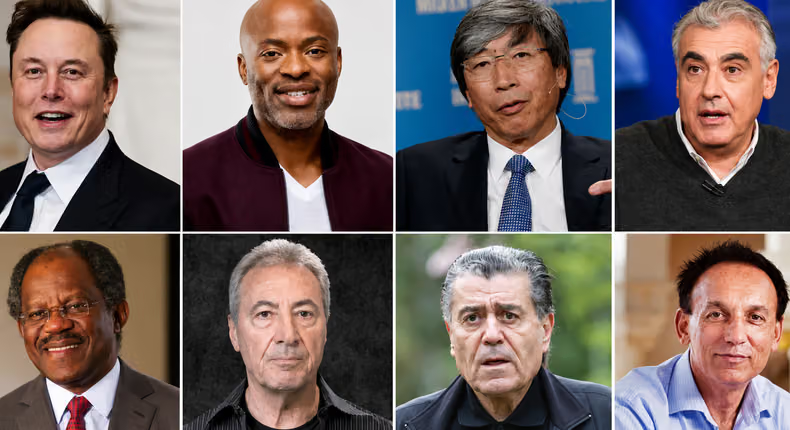
Nine African-born entrepreneurs have built a combined fortune of $952.9 billion in the United States, placing them among the wealthiest immigrants shaping America’s economy.
The group represents only 6.25 per cent of the 144 immigrant billionaires on Forbes’ 2026 ranking. Yet they control about 43.3 per cent of the group’s combined $2.2 trillion fortune.
That level of wealth looks like a major statement about African entrepreneurial influence. But one man accounts for almost all of it: South Africa-born Elon Musk.
Musk’s estimated $927 billion fortune represents more than 97 per cent of the total wealth held by the nine African-born billionaires.
America’s Immigrant Billionaire Class Is Growing
Forbes’ latest ranking includes a record 144 foreign-born US billionaires from 45 countries and territories.
Their combined wealth rose from $1.3 trillion in the previous year to $2.2 trillion in 2026.
Immigrants now account for nearly 15 per cent of America’s billionaires and hold about one-quarter of the country’s billionaire wealth.
The figures show how strongly migration continues to shape American enterprise.
Many of the founders and investors on the list built fortunes in sectors that drive modern economic power, including technology, healthcare, finance, infrastructure, media and consumer goods.
Africa’s nine representatives come from South Africa, Nigeria, Egypt, Morocco and Kenya.
Elon Musk Dominates the African List
Elon Musk leads the African-born group with an estimated net worth of $927 billion.
Born in Pretoria, South Africa, Musk built his fortune through companies including Tesla and SpaceX. His wealth places him far ahead of every other African-born billionaire in America.
His younger brother, Kimbal Musk, joined the ranking with an estimated fortune of $1.6 billion.
South Africa has two other representatives: physician and pharmaceutical entrepreneur Patrick Soon-Shiong, worth $9.8 billion, and Monster Beverage executive Rodney Sacks, worth $3.6 billion.
The four South African-born billionaires account for the largest share of Africa’s representation by both number and wealth.
Two Nigerians Make the Ranking
Nigeria is represented by Adebayo Ogunlesi and Tope Awotona.
Ogunlesi has an estimated net worth of $2.4 billion. He built his fortune through infrastructure investment and private equity.
The Nigerian-born executive previously led Global Infrastructure Partners, which developed a major portfolio of airports, energy assets and transport infrastructure.
Awotona, the founder of scheduling software company Calendly, is worth an estimated $1.4 billion.
He represents a newer generation of African technology founders who built global companies by solving simple but widespread business problems.
Calendly turned the frustrating process of arranging meetings into a software business used by individuals and companies worldwide.
Their presence on the list shows two different routes to billionaire status: investing in physical infrastructure and building scalable digital products.
The Other African-Born Billionaires
Egypt-born media investor Haim Saban has an estimated fortune of $3.3 billion.
Moroccan-born hedge fund manager Marc Lasry is worth about $2.2 billion, while Kenya-born technology entrepreneur Bharat Desai has an estimated fortune of $1.6 billion.
Together, the nine billionaires operate across several industries:
| Billionaire | Birth country | Estimated wealth | Main industry |
|---|---|---|---|
| Elon Musk | South Africa | $927bn | Technology and aerospace |
| Patrick Soon-Shiong | South Africa | $9.8bn | Healthcare and pharmaceuticals |
| Rodney Sacks | South Africa | $3.6bn | Consumer beverages |
| Haim Saban | Egypt | $3.3bn | Media and investments |
| Adebayo Ogunlesi | Nigeria | $2.4bn | Infrastructure and private equity |
| Marc Lasry | Morocco | $2.2bn | Finance and investments |
| Kimbal Musk | South Africa | $1.6bn | Technology and food ventures |
| Bharat Desai | Kenya | $1.6bn | Information technology |
| Tope Awotona | Nigeria | $1.4bn | Software |
The spread across industries matters. Africa’s representation does not come from one sector alone.
The list includes company founders, investors, healthcare entrepreneurs and executives who built wealth through both old-economy assets and technology-led businesses.
The 43 Per Cent Figure Needs Context
The nine billionaires control 43.3 per cent of America’s immigrant billionaire wealth, but that figure can create the wrong impression without context.
Musk alone accounts for about $927 billion of the group’s $952.9 billion fortune.
Without him, the remaining eight African-born billionaires would have a combined wealth of about $25.9 billion.
This does not diminish their achievements. It shows how one unusually large fortune can reshape an entire regional ranking.
A broader measure of African business influence would examine the number of founders, the companies they have built, jobs created, assets managed and industries transformed,not only their combined net worth.
What Their Success Says About African Talent
The list reflects a familiar pattern: African-born entrepreneurs often achieve global scale after gaining access to deeper capital markets, stronger infrastructure and larger customer bases abroad.
Their success raises an important question for African economies.
How many more billion-dollar companies could African founders build if they had better access to capital, stable power, efficient regulations and large connected markets at home?
The entrepreneurs on this list did not lack ambition or ability. They entered systems that made it easier to finance, scale and protect large businesses.
Africa continues to export talented founders, executives and investors. The larger opportunity is to build economies capable of retaining more of them, and giving the next generation a realistic path to create global companies without leaving the continent.


