
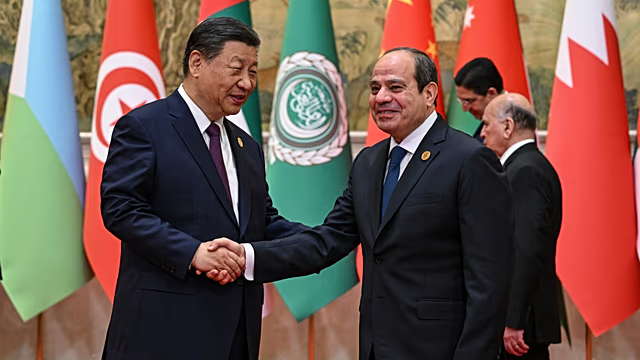
President Xi Jinping of China is visiting Cairo to hold high-level talks with his Egyptian counterpart, focusing on the expansion of bilateral trade and the deepening of infrastructure investment.
The visit comes as both nations seek to strengthen their “Comprehensive Strategic Partnership,” a framework designed to increase economic cooperation across manufacturing, energy, and technology sectors.
The talks are expected to focus on the integration of Egypt’s economic goals with the Belt and Road Initiative (BRI), China’s global infrastructure strategy that has already seen billions of dollars poured into African ports and railways.
China remains one of Egypt’s largest trading partners and a critical source of foreign direct investment. The discussions in Cairo are likely to address the scaling of industrial zones and the implementation of new trade agreements to reduce tariffs on Egyptian exports to Chinese markets.
Egyptian officials have previously highlighted the need for increased Chinese capital to support the country’s ambitious urban development and industrialisation goals, particularly as the government navigates a challenging macroeconomic environment marked by high inflation and currency volatility.
Chinese Investment in Egypt’s Infrastructure Hubs
A central pillar of the economic relationship is the Suez Canal Economic Zone (SCZONE), where Chinese companies have established a significant presence. The zone serves as a strategic gateway for Chinese firms looking to access markets in Europe, Africa, and the Middle East.
Chinese investment in the SCZONE has shifted from simple logistics to high-value manufacturing. This includes the establishment of textile factories and electronics assembly plants, aimed at transforming Egypt into a regional manufacturing hub.
Beyond the canal, China’s footprint is most visible in Cairo’s New Administrative Capital. Chinese state-owned enterprises were instrumental in constructing the Central Business District, which includes the tallest skyscraper in Africa.
This project represents one of the largest Chinese-funded urban developments in the region, reflecting Beijing’s willingness to provide large-scale financing for prestige infrastructure projects.
However, the scale of these investments has also brought scrutiny regarding Egypt’s external debt levels. Data from the World Bank indicates that Egypt has faced significant pressure to manage its debt-to-GDP ratio, making the terms of any new Chinese credit lines a critical point of negotiation during this summit.
The two leaders are also expected to discuss cooperation in the green energy transition. China, a global leader in solar and wind technology, has already begun partnering with Egyptian firms to develop renewable energy parks in the Western Desert.
These energy projects are designed to help Egypt meet its climate commitments while reducing its reliance on imported fuels, potentially creating a new export market for Egyptian green hydrogen.
The talks will also touch upon telecommunications and digital infrastructure. Huawei, China’s tech giant, continues to play a major role in the rollout of Egypt’s 4G and 5G networks, despite geopolitical pressures from Western allies.
The outcome of the visit is expected to be the signing of several Memoranda of Understanding (MoUs) covering trade facilitation, technical cooperation in agriculture, and joint ventures in the mining sector.
The summit concludes with a scheduled joint press conference, where the specific financial commitments and new project timelines are expected to be announced.
Explore more Business stories and analysis from Business Elites Africa.


