
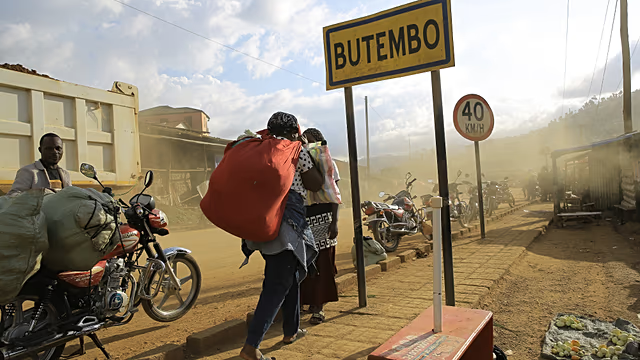
Médecins Sans Frontières (MSF) has issued a stark warning that the Ebola virus disease outbreak in the North Kivu province of the Democratic Republic of Congo (DRC) is now “out of control.” The international medical humanitarian organisation reported on Wednesday that the north-eastern region now accounts for nearly 40 per cent of all newly confirmed incidents nationwide.
The acceleration of the virus in North Kivu represents a significant setback for the DRC’s public health efforts and poses a direct threat to the stability of one of Africa’s most mineral-rich corridors. Local health authorities have struggled to contain the spread due to a combination of high population density, intense mobility, and persistent insecurity in the region.
According to the latest data released by Médecins Sans Frontières, the current transmission rate suggests that existing intervention strategies are failing to keep pace with the virus. The organisation noted that the epicentre has shifted toward urban centres, which complicates contact tracing and isolation protocols significantly compared to previous rural outbreaks.
The provincial capital of Goma, a critical hub for international trade and NGOs, is facing increased pressure as the caseload rises. Business leaders in the region have expressed concerns that a total lockdown or further restrictions on movement could paralyse the local economy, which serves as a gateway for goods entering from Uganda and Rwanda.
Mining Operations and Cross-Border Trade at Risk
The economic implications of an uncontrolled outbreak in North Kivu are profound. The province is a vital link in the global supply chain for 3Ts (tin, tantalum, and tungsten) and gold. While major industrial mines are often located further south or west, the artisanal and small-scale mining (ASM) sector in North Kivu provides a livelihood for hundreds of thousands of people and feeds into international markets.
Health experts warn that if the virus continues to spread through mining communities, the resulting labor shortages and site closures could disrupt exports. Furthermore, the World Health Organization (WHO) has previously noted that health crises in the DRC frequently lead to increased operational costs for companies, as they must implement stringent bio-security measures and medical evacuations.
Cross-border commerce is already feeling the strain. The DRC’s eastern borders are among the busiest in Central Africa for the transit of agricultural products and consumer goods. Increased health screenings at the border points with Uganda and Rwanda have already begun to slow down truck turnaround times, increasing logistics costs for regional importers and exporters.
The situation is further complicated by the volatile security landscape. North Kivu has been plagued by conflict involving various armed groups for decades. This insecurity prevents medical teams from reaching certain communities, allowing the virus to circulate undetected in what MSF describes as “blind spots” in the surveillance network.
Previous outbreaks in the DRC have shown that the economic cost extends beyond immediate healthcare spending. According to World Bank economic assessments of past health emergencies, the diversion of public funds to combat Ebola often results in the suspension of infrastructure projects and a decline in investor confidence.
International donors and the Congolese government are currently under pressure to scale up the response. The Ministry of Health in Kinshasa has announced plans to deploy additional vaccination teams to the region, targeting high-risk individuals and frontline workers. However, MSF insists that a more decentralised approach is required to regain control over the transmission chains.
The next few weeks will be critical for the provincial administration. If the 40 per cent share of national cases continues to rise, the central government may be forced to declare a state of emergency specifically for the eastern provinces, which would likely include stricter controls on commercial aviation and road transport.
Market analysts are monitoring the situation for potential impacts on commodity prices, particularly if logistical bottlenecks at the port of Mombasa or the Dar es Salaam corridor worsen due to health-related delays at the DRC border. For now, businesses operating in North Kivu are being advised to update their contingency plans and increase internal health monitoring for their workforces.
The WHO is expected to convene an emergency committee meeting in the coming days to determine if the situation warrants being declared a Public Health Emergency of International Concern (PHEIC), a move that would trigger further international resources but potentially lead to more restrictive travel and trade advisories.
Explore more News stories and analysis from Business Elites Africa.


