
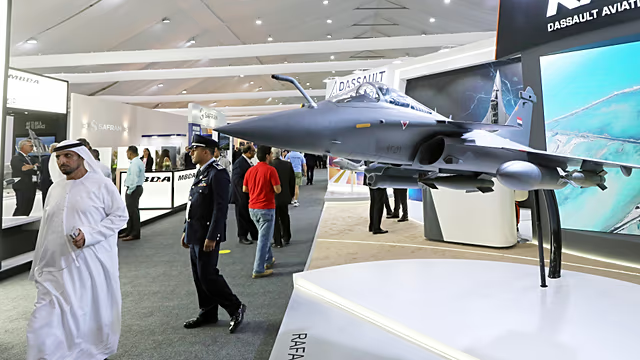
Egypt’s strategic push to become a regional hub for aerospace and defence technology has taken centre stage this week at the El Alamein International Air Show. The event, held at El Alamein International Airport on the country’s northwestern Mediterranean coast, has drawn more than 300 exhibitors from approximately 100 countries, highlighting Egypt’s growing influence in the global hardware market.
The air show serves as a critical platform for the Egyptian government to showcase its recent advancements in military hardware, with a particular focus on unmanned aerial vehicles (UAVs) and surveillance technology. Domestic entities, led by the Arab Organization for Industrialization (AOI), are using the forum to demonstrate locally manufactured components and assembly capabilities, signalling a move away from pure importation toward industrial self-sufficiency.
According to official reports from the Egyptian Ministry of Defence, the exhibition features a diverse array of aircraft, including the latest generation of fighter jets, transport planes, and multi-role helicopters. However, it is the rapid proliferation of drone technology that has dominated industry discussions. Chinese aerospace firms have maintained a significant presence, showcasing the Wing Loong series of armed drones, which have seen increasing adoption across African and Middle Eastern air forces.
The timing of the event is significant as Egypt seeks to diversify its economic base and attract foreign direct investment into its manufacturing sector. By hosting major international contractors such as Boeing, Lockheed Martin, and Airbus, Cairo is positioning the El Alamein Economic Zone as a potential site for maintenance, repair, and overhaul (MRO) facilities. These services are vital for the hundreds of aircraft operating within the region, representing a multi-billion dollar secondary market.
Egypt Targets Localisation in Bid for Regional Aerospace Dominance
A central theme of the 2026 exhibition is the “localisation” of technology. The Egyptian government has been vocal about its requirement for technology transfer in major procurement deals. This strategy aims to ensure that a higher percentage of the value chain—ranging from software development to the manufacturing of fuselage components—is retained within the Egyptian economy. This approach mirrors successful industrial policies in other emerging markets and is designed to create high-skilled employment for Egypt’s growing technical workforce.
Data from the Stockholm International Peace Research Institute (SIPRI) indicates that while Egypt remains one of the world’s largest importers of arms, the composition of these imports is shifting. There is a marked increase in the purchase of production licences and assembly kits, which allow Egyptian engineers to build hardware domestically under supervision. The El Alamein show provides the first public look at several of these collaborative projects, including advanced radar systems and light training aircraft.
Beyond the military applications, the event also addresses the commercial aviation sector. As African air traffic is projected to grow significantly over the next decade, the demand for regional jets and air traffic management systems is rising. Egyptian officials have held sideline meetings with various African transport ministers to discuss harmonising regulatory frameworks and improving cross-border connectivity. This commercial angle is part of Egypt’s broader ambition to integrate its economy more closely with the African Continental Free Trade Area (AfCFTA).
The presence of major investment houses and sovereign wealth funds at the show underscores the financial scale of the projects under discussion. Industry analysts suggest that the total value of Memorandums of Understanding (MoUs) signed during the week could exceed $3 billion. These agreements typically cover long-term infrastructure developments, including the expansion of Egyptian airports and the digitisation of air traffic control systems.
For private sector SMEs, the air show offers a rare opportunity to enter the supply chains of global aerospace giants. Large contractors are increasingly looking for local partners to provide specialised machining, wiring, and logistics services. The Egyptian Ministry of State for Military Production has established a dedicated pavilion to facilitate these business-to-business matches, aiming to integrate local firms into global production networks.
As the show concludes, the focus will shift to the implementation of the deals struck on the sidelines. The success of the El Alamein International Air Show will be measured not just by the spectacle of the flight displays, but by the volume of tangible industrial output and the growth of the domestic aerospace workforce in the coming years. The government is expected to release a comprehensive report on the economic outcomes of the event by the end of the quarter.
Explore more Business stories and analysis from Business Elites Africa.


