
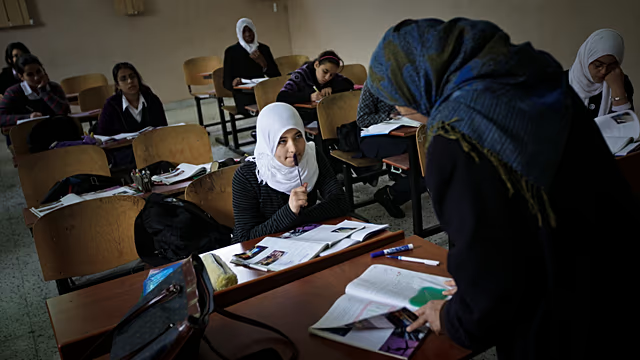
Public school teachers in Libya have entered their third consecutive week of industrial action, freezing the start of the academic year across several regions as they demand the full implementation of mandated salary increases. The strike, which has seen hundreds of educators gather in Tripoli’s Martyrs’ Square, highlights the growing tension between the country’s public sector workforce and the Government of National Unity (GNU) over fiscal priorities.
Central to the dispute is the activation of Law No. 4 of 2018, a legislative framework designed to restructure the education sector’s pay scale. While the government has made partial concessions in recent years, the General Syndicate of Teachers argues that the current disbursements fall short of the legal requirement, particularly in light of Libya’s soaring inflation and the continued devaluation of the Libyan Dinar.
The striking teachers are demanding not only the full adjustment of their basic salaries but also the payment of outstanding arrears dating back several years. Additionally, the syndicate is pushing for the provision of comprehensive health insurance, a benefit they claim is essential given the deteriorating state of public healthcare and the rising cost of private medical services in the country.
The protests in Tripoli have been mirrored by similar calls for action in other municipalities, indicating a rare moment of cross-regional solidarity in a nation often divided by political factions. For many educators, the strike is a last resort to address a standard of living that has plummeted as the cost of basic commodities continues to rise.
Fiscal Constraints and the Public Sector Wage Challenge
The standoff presents a significant challenge for the administration led by Prime Minister Abdulhamid al-Dbeibah. Libya’s public sector wage bill is one of the largest in the region relative to its GDP, consuming a massive portion of the national budget. According to data from the Central Bank of Libya, public sector salaries typically account for over 50% of total government spending, a figure that international financial institutions have frequently flagged as unsustainable.
Managing these demands is complicated by the volatile nature of Libya’s oil-dependent revenue stream. While oil production has remained relatively stable in recent months, the government faces competing pressures to fund infrastructure reconstruction, subsidise fuel, and maintain social safety nets. Critics of the government argue that despite the high spending, public services like education and health have seen little qualitative improvement, leading to the current sense of grievance among frontline workers.
Economists warn that meeting the teachers’ demands in full could trigger a domino effect, prompting other public sector unions—including healthcare workers and security personnel—to launch similar strikes for wage parity. This creates a difficult balancing act for the Ministry of Finance, which must weigh the necessity of maintaining industrial peace against the risk of further widening the fiscal deficit or triggering hyperinflation through excessive liquidity injections.
The World Bank’s economic analysis of Libya has consistently pointed to the need for comprehensive civil service reform to align pay with productivity and fiscal reality. However, in the current fragile political environment, such reforms are difficult to implement without risking widespread social unrest.
Beyond the immediate financial cost, the prolonged strike threatens to derail the academic calendar for hundreds of thousands of students. The disruption follows years of educational instability caused by conflict and the COVID-19 pandemic. Business leaders have expressed concern that continued gaps in schooling will further weaken Libya’s human capital, making it harder for the private sector to find skilled local talent in the future.
As the strike enters its fourth week, the General Syndicate of Teachers has indicated that it will not return to the classroom until a formal, binding agreement is signed with the GNU. The government has reportedly formed a committee to study the financial impact of the demands, but no timeline for a resolution has been announced. The next step will likely involve negotiations between the Ministry of Education and the Central Bank to determine if the 2024/2025 budget can accommodate the requested increases without jeopardising other essential services.
Explore more News stories and analysis from Business Elites Africa.


