
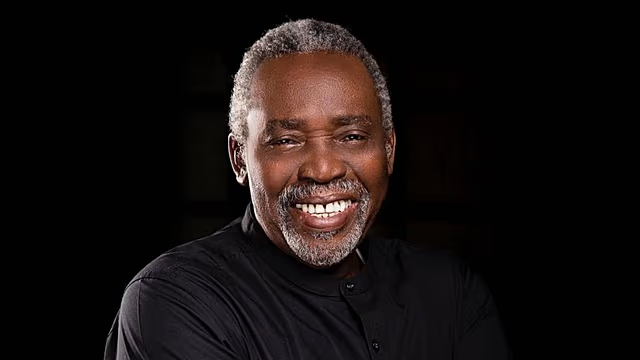
The Nigerian creative industry and the global African diaspora are mourning the death of veteran actor and industry patriarch Olu Jacobs, who passed away on Wednesday at the age of 84. His family confirmed the news in a statement, marking the departure of a figure widely regarded as one of the most influential African performers of the last half-century.
Born Oludotun Baiyewu Jacobs in 1942, the veteran actor was a bridge between the classic era of British stage and television and the explosive, multi-billion-naira commercial growth of the modern Nigerian film industry, popularly known as Nollywood. His career spanned over five decades, during which he appeared in several international productions and hundreds of Nigerian films, often portraying authoritative figures that commanded deep respect and gravitas.
Beyond his on-screen presence, Jacobs was a fundamental driver of professionalism in an industry that, for much of the 1990s, struggled with informal structures and inconsistent technical standards. Along with his wife, the celebrated actress Joke Silva, Jacobs founded the Lufodo Group, a conglomerate with interests in film production, distribution, and human capital development within the creative arts.
The Lufodo Academy of Performing Arts, a subsidiary of the group, has been instrumental in training a new generation of Nigerian actors and technical crew members. By institutionalising talent development, Jacobs and Silva provided a structured pipeline for the industry, helping to transition Nollywood from a high-volume video-film market into a more sophisticated cinematic economy capable of attracting institutional investment and global streaming interest.
The Commercial Transformation of African Cinema
The passing of Olu Jacobs comes at a time when the Nigerian film industry has become a critical component of the national economy. According to data from the National Bureau of Statistics (NBS), the motion picture, sound recording, and music production sector contributes approximately 2.3% to Nigeria’s Gross Domestic Product (GDP). This evolution from a grassroots movement to a major economic pillar was built on the reputation and professionalism of pioneers like Jacobs.
Jacobs was among the first generation of Nigerian actors to achieve significant success in the United Kingdom during the 1970s and 1980s. He trained at the prestigious Royal Academy of Dramatic Art (RADA) in London and appeared in numerous British television series, including The Tomorrow People, The Goodies, and Barlow at Large. His international experience allowed him to bring a level of discipline and theatrical rigour to Nigeria when he returned, setting a benchmark for younger actors who entered the industry during the home-video boom of the 1990s.
His commercial impact was further solidified through his leadership in the Lufodo Group. The company moved beyond mere production to address the infrastructure gaps in the Nigerian creative space. By focusing on the “Business of Arts,” Jacobs and Silva advocated for better royalty structures, intellectual property protection, and more robust distribution networks, which are essential for the long-term sustainability of the sector.
The industry’s growth has been documented by global consulting firms. In its Entertainment and Media Outlook, PwC has consistently highlighted Nigeria as one of the fastest-growing entertainment markets in the world. The professional standards championed by Jacobs played a vital role in making Nollywood content palatable for international platforms like Netflix and Amazon Prime Video, which have since invested millions of dollars into Nigerian original productions.
The recognition of his contributions went beyond box office figures. In 2013, Jacobs was honoured with the Industry Merit Award at the Africa Magic Viewers’ Choice Awards (AMVCA) for his outstanding contribution to the development of African cinema. He had previously received the Lifetime Achievement Award from the Africa Movie Academy Awards (AMAA) in 2007, reflecting his status as a dean of the acting profession in Africa.
The family has not yet announced funeral arrangements, but tributes have begun pouring in from government officials, business leaders, and fellow actors. Many have noted that his death represents the end of an era for the industry. However, the corporate and educational structures he established through the Lufodo Group are expected to continue his mission of professionalising the African screen.
As Nollywood continues its expansion into new markets and explores more complex financing models, the legacy of Olu Jacobs remains a foundational pillar. His transition from a stage actor in London to a business leader in Lagos serves as a blueprint for how talent can be leveraged into a sustainable commercial enterprise that benefits an entire national economy. The next steps for the Lufodo Group and the continued implementation of his professional standards will be closely watched by industry stakeholders.
Explore more News stories and analysis from Business Elites Africa.


