

President Bola Tinubu has approved salary increases of between 30 and 80 per cent for about 250,000 members of Nigeria’s Armed Forces.
The new structure will raise the military’s annual salary bill from ₦660 billion to ₦924 billion. This represents an additional ₦264 billion in yearly personnel costs and a 40 per cent increase in the wage bill.
The salary review will take effect on September 1, 2026. Junior personnel will receive the largest increases under a system designed to provide greater support to lower-ranking soldiers.
Personnel from private to staff sergeant will receive an 80 per cent increase. Warrant officers through colonels will receive 50 per cent, while brigadier-generals and generals will receive 30 per cent
The review is one of the largest military pay adjustments approved under Tinubu’s administration. It comes as Nigeria continues to confront terrorism, banditry, kidnapping, crude oil theft and other security threats.
However, the announcement also raises an important question: will the higher wage bill translate into better welfare and stronger security performance?
Junior Personnel Will Receive the Biggest Increase
The government structured the salary review to give the highest percentage increase to lower-ranking personnel.
This approach reflects the financial pressure facing junior soldiers, many of whom earn less than senior officers while carrying much of the burden of frontline operations.
Before the latest announcement, Defence Minister Christopher Musa said the minimum monthly salary of a Nigerian soldier had increased from about ₦49,000 to ₦100,000. He also indicated that the government was working on another review.
Under the new structure, an 80 per cent increase would significantly raise the earnings of junior soldiers. However, the government has not published a complete salary table showing the new monthly earnings for every rank.
One senior officer cited in the source report estimated that a 50 per cent increase would raise his monthly salary from ₦362,405.67 to about ₦543,608.51.
The graduated structure may help narrow some of the income gap between junior and senior personnel. It could also make military service more attractive at a time when poor welfare has affected recruitment and retention.
Military Wage Bill Rises by ₦264bn
The salary review will add ₦264 billion to the government’s annual military personnel costs.
That is a major recurring financial commitment. Unlike a one-off equipment purchase, salaries must be funded every year.
The Federal Government will therefore need to support the increase with reliable budget allocations and timely releases.
This is particularly important because serving personnel and retired officers have raised concerns about delays in implementing previous welfare promises.
Some serving soldiers said they would reserve judgment until the new salaries appeared in their bank accounts. They described implementation, rather than the announcement itself, as the real test of the government’s commitment.
Retired Brigadier-General George Emdin also warned that earlier welfare announcements had sometimes lacked adequate cash backing. He said the impact of the latest review would only become clear after implementation.
The government’s immediate challenge is therefore not simply to approve the increase. It must fund the additional cost without allowing salary arrears to build up.
Higher Salaries Could Improve Recruitment and Morale
Military veterans and serving officers generally welcomed the increase.
Supporters said better pay could improve morale, reduce resignations and encourage more Nigerians to consider military careers.
Retired Brigadier-General Bashir Adewinbi argued that improved salaries could strengthen commitment and make military service more attractive to potential recruits. However, he also acknowledged that inflation had reduced the purchasing power of workers’ earnings.
The government has linked the pay rise to the risks personnel face while fighting insurgency, kidnapping and banditry.
Tinubu said Nigeria could not achieve meaningful national development without security. He also promised that his administration would continue to improve troop welfare while providing the Armed Forces with modern equipment and technology.
Better salaries may ease some of the financial pressure on military families. They could also reduce the number of trained personnel leaving the service because of poor pay.
However, salaries alone will not resolve the deeper welfare and operational problems facing the Armed Forces.
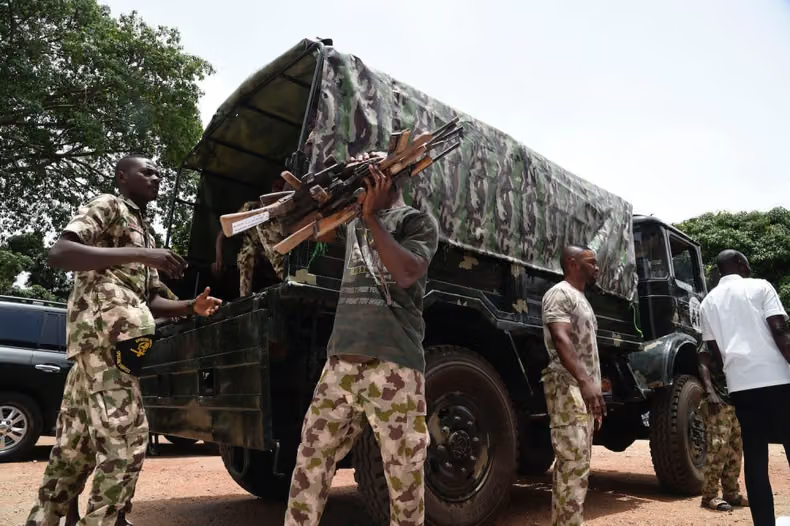
Troops Still Need Equipment, Housing and Healthcare
Retired military officers said the salary review must be supported by better equipment, accommodation, healthcare, insurance and logistics.
Personnel deployed to difficult areas need reliable weapons, protective equipment, transportation and intelligence support. They also need decent housing and access to healthcare for themselves and their families.
Adewinbi said the government should not stop at salaries. He called for modern weapons, better uniforms, suitable accommodation and stronger logistical support.
Retired Colonel Ahmed Usman also called for continuous training, comprehensive insurance, healthcare and decent housing for service personnel and their families.
These demands show that troop welfare extends beyond monthly earnings.
A soldier may receive a higher salary but still struggle if military accommodation is poor, medical support is limited or the equipment needed for operations is unavailable.
The salary increase should therefore form part of a wider plan covering welfare, training, equipment and accountability.
Will Higher Pay Improve Security?
The government expects the salary review to improve morale and operational effectiveness.
Better-paid personnel may feel more valued and become more willing to remain in the service. Higher earnings may also support recruitment and reduce the financial strain on military households.
But improved remuneration does not automatically produce better security outcomes.
Nigeria has continued to face attacks by insurgents, bandits and kidnappers despite years of military spending and expanded deployments.
The government will still need to address intelligence failures, weak inter-agency coordination, equipment gaps and poor working conditions.
There must also be clear performance expectations. Higher funding and improved welfare should be matched by professionalism, discipline, respect for human rights and stronger cooperation among security agencies.
The salary review is an important investment in the people responsible for protecting the country. Yet its success will depend on three factors: whether the money is paid on time, whether broader welfare problems are addressed and whether improved compensation leads to measurable security gains.
For now, the approval raises the military wage bill to ₦924 billion.
The next test begins on September 1, when personnel expect the new figures to reach their bank accounts.


