
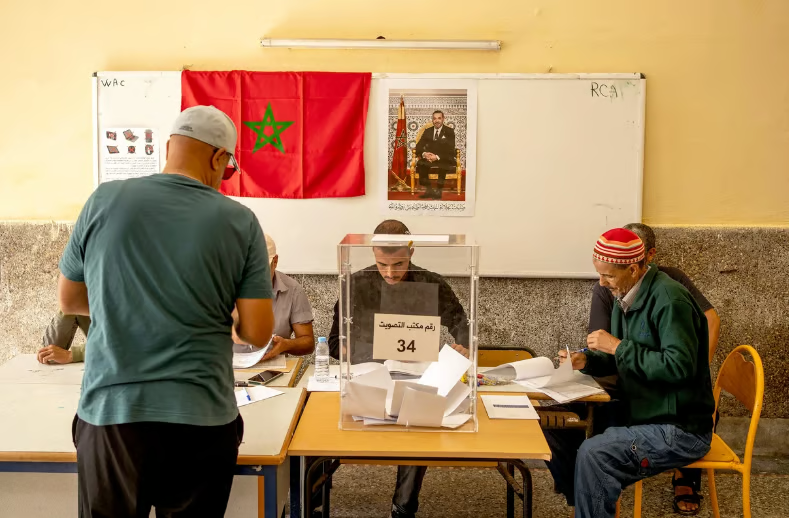
Morocco’s Authenticity and Modernity Party (PAM) has emerged as the largest force in the House of Representatives following the 2026 general elections, fundamentally altering the political landscape that has been dominated by a business-aligned coalition for the past five years. The preliminary results, confirmed by the Ministry of the Interior, show a significant retreat for the National Rally of Independents (RNI), led by billionaire Prime Minister Aziz Akhannouch.
The shift in parliamentary power comes at a critical juncture for Africa’s fifth-largest economy as it navigates an ambitious $12 billion investment programme ahead of the 2030 FIFA World Cup. While the RNI has overseen a period of technocratic governance and aggressive infrastructure spending, the 2026 vote reflects a public response to persistent inflationary pressures and a perceived gap between macroeconomic growth and household stability.
Data from the election commission indicates that the PAM has secured the top spot, though it will require coalition partners to form a functional government. Perhaps more surprising to regional observers is the resurgence of the Islamist Justice and Development Party (PJD). After being decimated in the 2021 polls, where they dropped to just 13 seats, the PJD has rebounded to claim 54 seats, positioning itself once again as a vocal force in Moroccan fiscal and social policy.
Under Article 47 of the Moroccan Constitution, King Mohammed VI must appoint a Head of Government from the political party that topped the election results. This constitutional mandate ensures that the PAM will lead the negotiations to form the next executive branch, though the King retains significant influence over strategic portfolios including defense, foreign policy, and religious affairs.
Economic Continuity and Investor Confidence Under New Leadership
The primary concern for international investors and domestic business leaders is the continuity of the “New Development Model,” a long-term economic roadmap designed to double Morocco’s GDP by 2035. The RNI-led government was largely viewed as the primary architect of this business-friendly environment, successfully attracting record Foreign Direct Investment (FDI) in the automotive and aeronautics sectors. According to recent data from the Foreign Investment Observatory, Morocco has recently solidified its position as a primary hub for green hydrogen and battery manufacturing in Africa.
The PAM, despite its different political origins, is widely expected to maintain the broad strokes of Morocco’s liberal economic agenda. The party has historically supported private sector growth and the acceleration of the country’s industrial acceleration plan. However, analysts suggest that a PAM-led government may face immediate pressure to pivot toward more aggressive social spending to address the cost-of-living concerns that contributed to the RNI’s electoral losses.
Fiscal policy will be a major point of contention in upcoming coalition talks. Morocco is currently managing a delicate balance between funding massive social protection programmes and maintaining the budget deficit targets agreed upon with international lenders. The International Monetary Fund (IMF) has previously lauded Morocco’s resilience to shocks, including the 2023 Al Haouz earthquake, but has cautioned that sustained growth will depend on deeper structural reforms in the labour market and the education system.
The banking and finance sectors are also closely watching for any shifts in regulatory policy. The Casablanca Stock Exchange has seen a period of relative stability, bolstered by the performance of major institutions like Attijariwafa Bank and BCP. Any significant change in the government’s approach to taxation or the subsidies on butane gas and flour—issues that the resurgent PJD has historically championed—could introduce new volatility into the domestic market.
The immediate next step in the political transition will be the King’s formal invitation to the PAM leadership to begin consultations. This process can be lengthy; in previous cycles, the formation of a majority coalition has taken several weeks of intense horse-trading between the leading parties. The RNI, despite its losses, remains a potent political and economic force and may yet find a place as a junior partner in a PAM-led coalition, which would signal to markets a high degree of policy continuity.
For the broader African continent, Morocco’s election results are a significant indicator of the stability of its democratic institutions and its continued trajectory as a regional investment gateway. As the country prepares for the next phase of its economic evolution, the incoming administration will be tasked with proving that it can translate high-level industrial success into tangible improvements for the Moroccan workforce and small-to-medium enterprises (SMEs).
Explore more Politics stories and analysis from Business Elites Africa.


