

The African economic landscape in 2026 is a testament to resilience and strategic fiscal reform. While global markets have faced volatility, several African nations have successfully stabilized their legal tender through aggressive monetary policies, mineral wealth, and a shift toward diversified exports.
For investors, travelers, and business leaders, understanding currency strength is not just about exchange rates,It is a barometer for political stability and purchasing power. In this guide, we dive deep into the top 10 African currencies as of April 2026, analyzing the factors that keep them at the top.
What Determines Currency Strength in Africa?
Currency strength is often misunderstood as a direct reflection of a country’s total wealth. However, in the African context, it is largely driven by:
- Monetary Policy: The independence of Central Banks in controlling inflation.
- Commodity Prices: Gold, oil, and diamond exports significantly buoy currencies like the Pula and the Kwanza.
- Foreign Direct Investment (FDI): Stability attracts the USD and EUR, increasing local demand.
- Currency Pegging: Several strong currencies are pegged to the Euro or the US Dollar, providing an artificial but effective layer of stability.
Top 10 Strongest African Currencies (April 2026)
The following rankings are based on their exchange value against the United States Dollar (USD).
| Rank | Country | Currency | ISO Code | Key Driver |
| 1 | Tunisia | Tunisian Dinar | TND | Controlled Export Policy |
| 2 | Libya | Libyan Dinar | LYD | Central Bank Oil Revenues |
| 3 | Morocco | Moroccan Dirham | MAD | Tourism & Manufacturing |
| 4 | Botswana | Botswana Pula | BWP | Diamond Exports & Low Debt |
| 5 | Seychelles | Seychellois Rupee | SCR | High-end Tourism |
| 6 | Eritrea | Eritrean Nakfa | ERN | Fixed Exchange Regime |
| 7 | Ghana | Ghanaian Cedi | GHS | Rebound in Gold & Cocoa |
| 8 | Namibia | Namibian Dollar | NAD | Pegged to SA Rand |
| 9 | South Africa | South African Rand | ZAR | Industrialization & Mining |
| 10 | Eswatini | Lilangeni | SZL | Pegged to SA Rand |
1. Tunisian Dinar (TND)
The Tunisian Dinar remains the strongest currency in Africa. The government’s strict policy against importing or exporting Dinars helps keep inflation at bay. Tunisia’s diversified economy, ranging from agriculture to clothing exports, provides a stable foundation for its currency.

2. Libyan Dinar (LYD)
Despite historical political fragmentation, the Libyan Dinar maintains its value primarily due to the country’s massive oil reserves. The Central Bank of Libya maintains a tightly managed float, ensuring that the currency remains strong compared to its regional peers.

3. Moroccan Dirham (MAD)
Morocco’s Dirham is a “heavyweight” due to the country’s proximity to Europe and its liberalized trade agreements. In 2026, Morocco has seen a surge in green energy investments and automotive manufacturing, which has significantly bolstered the Dirham’s credibility on the global stage.

4. Botswana Pula (BWP)
The Pula has long been a symbol of African economic success. Botswana’s prudent management of its diamond wealth and its low external debt makes the Pula a favorite for regional investors.

5. Seychellois Rupee (SCR)
As a small island nation with a high-income economy, the Seychelles relies on a sophisticated tourism sector. The Rupee is fully convertible and stays strong due to consistent foreign exchange inflows from luxury travelers.

Case Study: The Ghanaian Cedi’s 2025-2026 Recovery
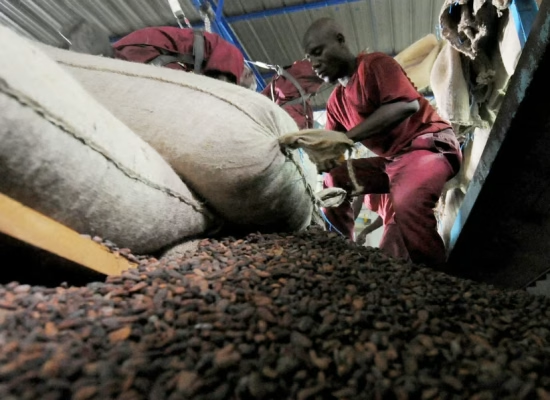
A notable entry in this year’s list is the Ghanaian Cedi. Following a period of high inflation in 2023, the Ghanaian government implemented a “Gold for Oil” policy and restructured its debt under IMF supervision. By April 2026, the Cedi has stabilized, reclaiming its spot among the top 10 as gold prices hit record highs. This serves as a primary example of how fiscal discipline can resuscitate a struggling currency.
Expert Insights: Why the Nigerian Naira and Egyptian Pound are Missing
Many are surprised to see Africa’s largest economies-Nigeria and Egypt-missing from the top 10 list. While these nations have high GDPs, their currencies have faced significant devaluation due to high inflation rates and foreign exchange liquidity challenges.
According to reports from Africa Business Insider, the focus for these nations in 2026 remains on narrowing the gap between official and parallel market rates.
Investment Implications for 2026
For businesses looking to expand into Africa, a strong currency indicates lower “exchange rate risk.” However, it is also important to look at Liquidity. While the Eritrean Nakfa is “strong” on paper due to a fixed rate, it is far less liquid than the South African Rand.
Key takeaway for investors:
- For Stability: Look toward the Pula (Botswana) or Dirham (Morocco).
- For High Growth: Look toward the Cedi (Ghana) as it continues its recovery trajectory.
For more detailed economic forecasts, you can consult the World Bank Africa Pulse for quarterly updates on regional growth.
Frequently Asked Questions (FAQ)
Which is the strongest currency in Africa in 2026?
The Tunisian Dinar (TND) currently holds the title of the strongest currency in Africa based on its exchange rate against the USD.
Why is the Libyan Dinar so strong?
The Libyan Dinar is backed by the country’s extensive oil reserves and a controlled monetary policy by its Central Bank, which limits the supply of the currency.
Does a strong currency mean a strong economy?
Not necessarily. A strong currency means the legal tender has high purchasing power against other currencies, but a country can have a strong currency and still face issues like high unemployment or low GDP growth.
How does the South African Rand affect other currencies?
The currencies of Namibia (NAD), Eswatini (SZL), and Lesotho (LSL) are pegged 1:1 to the South African Rand. If the Rand fluctuates, these currencies follow suit.


One thought on “Top 10 African Countries with the Strongest Currencies in April 2026”