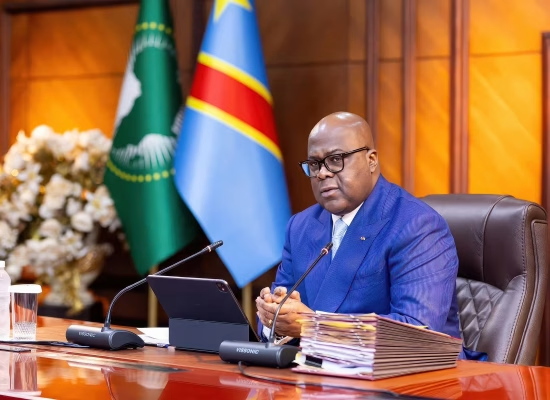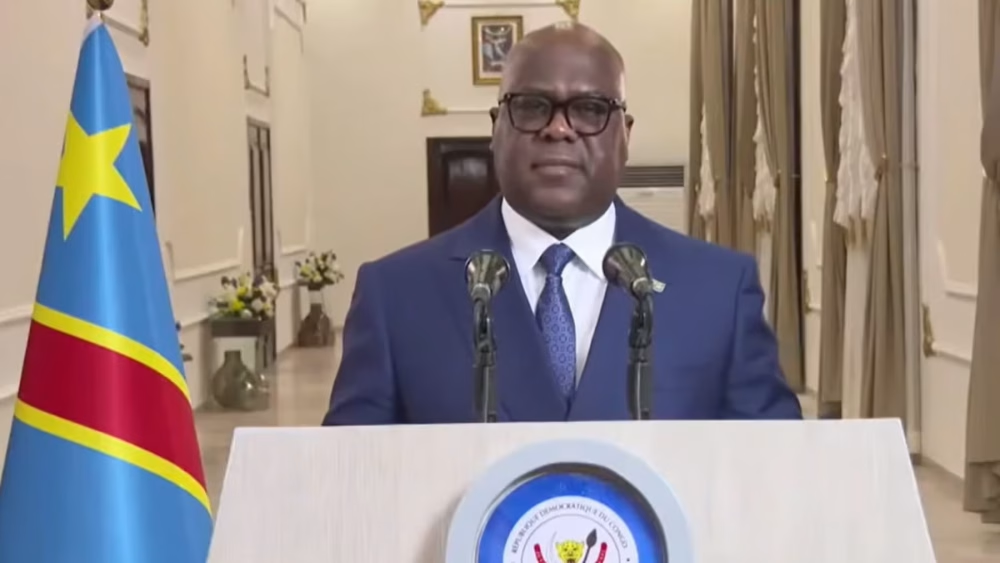
President Félix Tshisekedi has announced the launch of a national dialogue to address the persistent instability in the Democratic Republic Congo (DRC), explicitly ruling out the participation of the AFC/M23 rebel coalition.
The president stated that the dialogue process would last for a maximum of three months. While the leadership of the rebel groups remains barred, Tshisekedi noted that a door remains open for individual fighters who choose to renounce armed struggle and reintegrate into civilian life.
The decision to exclude the Alliance Fleuve Congo (AFC) and the M23 movement comes amid a period of heightened tension in the eastern provinces. The AFC, a coalition led by former intelligence chief Corneille Nangaa, has sought to consolidate various armed groups to challenge the central government in Kinshasa.
This diplomatic move follows several failed or stalled attempts to reach a comprehensive peace agreement through regional mediation. The DRC government has consistently accused Rwanda of supporting the M23 rebels, a claim that Kigali continues to deny.
The focus of the three-month dialogue is expected to center on internal governance and the restoration of state authority in territories currently held by various armed factions. By limiting the dialogue to domestic actors and individual defectors, the administration aims to isolate the rebel leadership and weaken the AFC’s operational capacity.
Mining Interests and Regional Stability
The security vacuum in eastern DRC has direct consequences for the country’s economy and global supply chains. The region is a primary source of critical minerals including coltan, gold, and tin, which are essential for electronics and green energy technologies.
Instability has frequently led to the disruption of mining operations and the proliferation of illicit trade networks. According to data from the World Bank, the DRC’s economic potential is consistently hampered by conflict, which displaces millions of people and destroys critical infrastructure.
Investment in the DRC’s mining sector remains volatile due to these security risks. International firms operating in the region must navigate a complex landscape of state regulation and local militia interference, which increases the cost of doing business and complicates the implementation of ethical sourcing standards.
Previous diplomatic efforts, such as the United Nations backed Luanda process and the Nairobi process, attempted to bring the DRC and Rwanda closer to a ceasefire. However, the resurgence of M23 activity in North Kivu has effectively undermined those frameworks.
The current administration’s strategy reflects a shift toward internal consolidation over external negotiation. By establishing a strict timeline for the national dialogue, Tshisekedi is attempting to project a sense of urgency and decisive leadership to both domestic allies and international partners.
The success of this initiative depends largely on whether the dialogue can produce a viable roadmap for reintegration that appeals to rank-and-file fighters. If the AFC/M23 leadership perceives the dialogue as a tool for surrender rather than negotiation, the risk of increased military escalation in the east remains high.
The DRC government is now tasked with defining the specific terms under which rebel fighters can renounce their arms. The outcome of this process will likely determine the security environment for the remainder of the year, influencing both regional stability and the flow of mineral exports from the eastern provinces.
The dialogue is scheduled to conclude within the next 90 days, at which point the government is expected to present a final framework for national reconciliation and state reintegration.
Explore more Politics stories and analysis from Business Elites Africa.